
Amazon Affiliate Disclosure
Geronutrition.com may participate in affiliate programs, including the Amazon Services LLC Associates Program. This means we may earn a commission when readers purchase qualifying products through affiliate links, at no additional cost to the buyer.
Our editorial approach is designed to separate education from promotion. Product mentions, supplement discussions, nutrition tools, and buyer guidance should be understood as informational resources, not medical diagnosis, treatment, or personalized clinical advice. Older adults, caregivers, and anyone using medications should consult a qualified healthcare professional before starting supplements or making major dietary changes.
Geronutrition is not just “healthy eating for seniors.” It is a more advanced way of thinking about nutrition after midlife: how food, protein, micronutrients, supplements, digestion, muscle health, inflammation, appetite, metabolism, and daily routines work together as the body ages.
As research in Longevity Science continues to evolve, geronutrition has become one of the most important evidence-based strategies for supporting healthy aging, preserving physical function, and improving quality of life.
That is why learning how to use geronutrition matters.
At Geronutrition, the goal is to help older adults, caregivers, wellness readers, and health-focused families move from scattered nutrition advice into a structured aging-nutrition strategy. Instead of asking one isolated question — “What supplement should I take?” or “What should my parent eat?” — geronutrition asks a better question:
What does this aging body need now, what is changing, and how can nutrition support function, independence, strength, and quality of life over time?
This guide explains how to use Geronutrition.com as a complete learning center. You will see where to begin, how to move through the site, how to compare nutrition programs and supplements, what to watch for, what costs to expect, and how to avoid common mistakes.
Quick Picks
| Visitor Goal | Start Here | Best For |
|---|---|---|
| I am new to aging nutrition | What Is This Guide For? | Beginners, caregivers, adult children, and readers who want a clear introduction to geronutrition. |
| I want to understand the benefits before starting | Benefits of Using Geronutrition | Readers comparing healthy aging nutrition, prevention, strength support, energy, appetite, and long-term wellness benefits. |
| I want to know how geronutrition works | How Geronutrition Works | People who want to understand how aging affects metabolism, appetite, absorption, protein needs, muscle health, and daily nutrition. |
| I want a step-by-step system | How to Build a Geronutrition Plan | Older adults, caregivers, and families who need practical daily planning. |
| I want to use this website in the right order | How to Use Geronutrition.com in the Right Order | Visitors who want a clear path through the site without jumping randomly between articles. |
| I am researching supplements | Geronutrition Supplements | Readers comparing protein powders, vitamin D, omega-3, creatine, collagen, and other healthy aging supplements. |
| I need recipes and food ideas | Healthy Recipes & Nutrition Programs | Meal planning, senior recipes, caregiver grocery support, appetite-friendly meals, and structured nutrition programs. |
| I want to compare approaches | Geronutrition vs General Nutrition | Readers who want to understand what changes after midlife and why older adults need more targeted nutrition guidance. |
| I am worried about safety | Risks and Safety Checks | Medication users, frail adults, people with chronic conditions, caregivers, and supplement buyers. |
| I want tools and checklists | Clinical Tools & Resources | Tracking, screening, protein logs, hydration checks, meal review, and patient-friendly education. |
| I want to look ahead | Want to Take a Look in the Future? | Readers interested in longevity science, AI nutrition planning, precision supplementation, biomarkers, and the future of geronutrition. |
What Is This Guide For?
This guide is for visitors who want to understand what is geronutrition and how to use Geronutrition.com properly, instead of reading one article at random and leaving with disconnected information.
A strong geronutrition strategy usually involves several layers:
- Understanding how nutritional needs change with age
- Learning how protein, muscle, appetite, digestion, hydration, and micronutrients interact
- Comparing food-first strategies with supplement support
- Building meal routines that match real energy levels, chewing ability, appetite, and budget
- Using tools, checklists, and structured resources to make better decisions
- Knowing when professional clinical support is needed
The best way to use the site is not to treat it like a product catalog. Treat it like a map.
Start with education. Then move into planning. Then compare supplements, recipes, and tools only after you understand the person’s actual nutrition needs.
Who Needs Geronutrition?
Geronutrition is useful for anyone who wants to age with better strength, better function, and more intentional nutrition. But some groups benefit more urgently than others.
Older Adults After 50
After midlife, nutrition becomes less forgiving. A poor breakfast, low protein intake, skipped meals, dehydration, or a narrow diet may not show immediate consequences, but over time these patterns can affect energy, muscle, balance, appetite, and recovery.
Older adults often need a more deliberate food structure than younger adults. That does not mean complicated dieting. It means meals should have a purpose: protein for muscle, fiber for digestion, hydration for function, minerals for bone and nerve support, and enough calories to prevent unintended weight loss.
Adults Caring for Aging Parents
Caregivers often notice changes before the older adult does. A parent may eat less, lose interest in meals, avoid meat because it is hard to chew, forget to drink water, or rely heavily on tea, biscuits, toast, or soft convenience foods.
Geronutrition helps caregivers move from worry into observation. Instead of guessing, caregivers can look at patterns: appetite, weight changes, meal frequency, protein intake, swallowing comfort, grocery access, medication timing, and fatigue after meals.
People Researching Longevity Nutrition for Older Adults
Many readers are not yet elderly but want to build a long-term nutrition strategy. For them, geronutrition offers a bridge between wellness culture and practical aging science. It avoids the fantasy of “anti-aging” and focuses on function: muscle, metabolism, cognition, mobility, digestion, and resilience.
Clinicians, Coaches, and Wellness Businesses
Geronutrition.com can also support professionals who need patient-friendly explanations. A dietitian, care coordinator, health coach, senior living operator, supplement brand, or wellness educator may use the site as a reference point for communicating aging nutrition in a more structured way.
Benefits of Using Geronutrition Correctly
When used properly, geronutrition can change the way a person thinks about food after midlife. The benefit is not just “better diet.” The real benefit is better decision quality.
Better Nutrition Prioritization
Many older adults do not need a complicated wellness stack. They need the basics handled well: enough protein, enough energy, enough fluids, enough fiber, and enough micronutrient coverage. Geronutrition helps readers separate urgent needs from decorative wellness trends.
Stronger Muscle and Mobility Support
Nutrition alone cannot replace movement, but it can support the body’s ability to maintain muscle. Protein distribution, meal timing, amino acid quality, vitamin D status, hydration, and resistance-friendly meal patterns all matter when the goal is strength preservation.
Smarter Supplement Decisions
The supplement market is crowded. Geronutrition helps readers ask better questions before buying: Is there a deficiency? Is the product appropriate for age? Does it duplicate another supplement? Could it interact with medication? Is the dose sensible? Is food a better starting point?
Readers exploring Longevity supplements should use them as targeted support, not as replacements for meals, sleep, movement, or clinical care.
Better Caregiver Communication
A caregiver who says “you need to eat better” may face resistance. A caregiver who says “let’s add one high-protein breakfast and one softer dinner option this week” has a better chance of success.
Geronutrition turns broad concern into manageable steps.
More Confidence Around Aging Nutrition Choices
The internet is full of conflicting advice. Geronutrition gives readers a way to organize information by need: muscle support, appetite loss, frailty risk, supplement safety, meal plans, recipes, digestion, and clinical tools.
How Geronutrition Works?
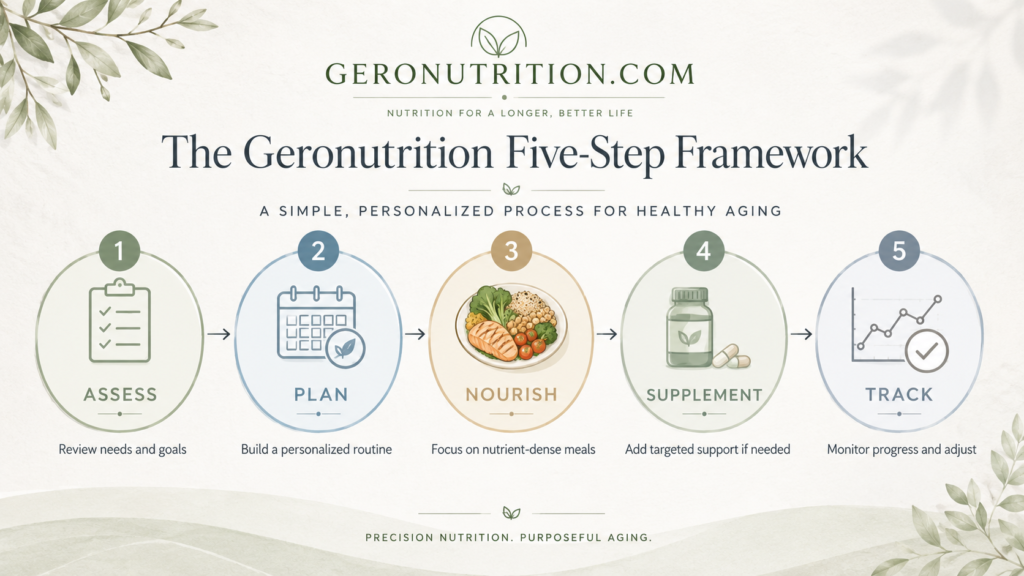
Geronutrition works by matching nutrition strategy to aging physiology.
A younger adult may tolerate irregular meals, low protein days, poor sleep, and aggressive dieting with fewer obvious consequences. An older adult often has less reserve. Recovery may be slower. Appetite may be lower. Muscle may be harder to rebuild. Medications may affect taste, digestion, appetite, hydration, or nutrient status.
That means nutrition after midlife must become more intentional.
A useful geronutrition framework has five layers:
| Layer | What It Looks At | Why It Matters |
|---|---|---|
| Intake | Meals, snacks, fluids, protein, calories | Shows whether the person is eating enough |
| Function | Strength, walking, fatigue, balance, daily activity | Connects food to real-life independence |
| Metabolism | blood sugar patterns, body composition, inflammation tendencies | Helps personalize the nutrition plan |
| Tolerance | chewing, swallowing, digestion, appetite, medication timing | Prevents unrealistic meal planning |
| Support | supplements, caregiver routines, tools, professional guidance | Fills gaps without replacing food |
This is the core idea: geronutrition is not just about what is “healthy.” It is about what is useful for this person, at this age, with this body, this appetite, this budget, this routine, and this level of risk.
How to Build a Geronutrition Plan
A geronutrition plan should be simple enough to follow and structured enough to make a difference. The best plan is not the most impressive one on paper. It is the one that survives real mornings, real appetite, real grocery habits, real cooking capacity, and real medical complexity.
Step 1: Identify the Main Aging Nutrition Goal
Start with one primary goal. Do not try to fix everything at once.
Common goals include:
| Goal | Nutrition Priority |
|---|---|
| Maintain muscle | Protein, strength-supporting meals, meal timing |
| Improve energy | Meal consistency, hydration, iron/B12 evaluation if appropriate |
| Reduce frailty risk | Calories, protein, vitamin D, resistance-friendly nutrition |
| Support brain health | Mediterranean-style eating, omega-3-rich foods, colorful plants |
| Improve appetite | Smaller meals, calorie density, texture changes |
| Support digestion | Fiber, fluids, meal rhythm, gut-friendly foods |
| Manage weight after 60 | Protein-first structure, lower ultra-processed intake, realistic portions |
Step 2: Build Meals Around Protein First
For older adults, protein is not just a fitness topic. It is a function topic.
A practical plate structure may include:
| Meal Component | Practical Examples |
|---|---|
| Protein | eggs, yogurt, lentils, fish, chicken, tofu, cottage cheese, beans, lean meat |
| Fiber-rich carbohydrate | oats, whole grains, sweet potato, fruit, beans |
| Healthy fats | olive oil, avocado, nuts, seeds |
| Color | vegetables, berries, herbs, leafy greens |
| Fluids | water, soups, milk, unsweetened drinks |
The goal is not to make every meal perfect. The goal is to stop letting protein become an afterthought.
Step 3: Adjust for Chewing, Swallowing, and Appetite
A geronutrition plan fails when it ignores real eating barriers.
If chewing is difficult, use softer proteins: eggs, yogurt, fish, lentils, minced meat, soft tofu, cottage cheese, smoothies, soups, and stews.
If appetite is low, use smaller but denser meals. Add olive oil, nut butter, full-fat yogurt, avocado, powdered milk, or protein-rich sides where appropriate.
If cooking is exhausting, simplify the meal system: batch-cooked soup, boiled eggs, pre-washed vegetables, frozen berries, canned beans, Greek yogurt, and prepared grains.
Step 4: Use Supplements Only After Identifying the Gap
Supplements can be useful, but they are not a shortcut around poor meal structure. The smarter question is not “What supplement is best?” It is “What problem am I trying to solve?”
A supplement may be considered when:
| Situation | Possible Support Area |
|---|---|
| Low protein intake | protein powder, essential amino acids, high-protein meal support |
| Low vitamin D status | vitamin D under professional guidance |
| Limited animal foods | B12 assessment and possible supplementation |
| Poor appetite | nutrition shakes or calorie-dense meal support |
| Muscle loss concerns | protein, creatine discussion, resistance-supporting nutrition |
| Gut issues | fiber strategy, food tolerance review, possibly probiotics |
A supplement should have a purpose, a dose, a timeline, and a safety check.
Geronutrition Supplements: How to Use Supplements Without Overdoing It
The phrase geronutrition supplements attracts strong commercial interest because many people want a product-based answer. But the best supplement strategy for aging adults is usually selective, not excessive.
A good supplement routine should pass five tests:
| Test | Question to Ask |
|---|---|
| Need | What gap is this addressing? |
| Safety | Is it safe with medications and conditions? |
| Dose | Is the amount appropriate for age and health status? |
| Duplication | Is the nutrient already in another product? |
| Outcome | What should improve, and when will we reassess? |
Food-First vs Supplement-First
| Approach | Strength | Weakness | Best Use |
|---|---|---|---|
| Food-first geronutrition | Supports protein, fiber, micronutrients, digestion, and satiety together | Requires planning and consistency | Most older adults and caregivers |
| Supplement-first approach | Convenient and measurable | Can miss the larger diet problem | Specific gaps, poor intake, clinical need |
| Hybrid approach | Combines meals with targeted support | Requires careful product selection | Most realistic for aging adults with changing needs |
The hybrid approach is often the most practical. Meals form the foundation. Supplements fill narrow gaps.
Geronutrition vs General Nutrition: What Changes After Midlife?
Many nutrition articles are written for a broad adult audience. Geronutrition is more specific. It looks at aging-related changes that general nutrition advice often treats too lightly.
Geronutrition vs General Nutrition Comparison Chart
| Category | General Nutrition | Geronutrition |
|---|---|---|
| Main Goal | Weight, energy, general wellness | Function, muscle, independence, resilience |
| Protein Emphasis | Often moderate | More strategic and meal-distributed |
| Calories | Often focused on reduction | May focus on preventing under-eating |
| Supplements | Often trend-driven | Gap-driven, safety-focused |
| Meal Planning | Lifestyle preference | Appetite, chewing, digestion, medication, caregiver support |
| Risk Lens | General health | Frailty, sarcopenia, falls, dehydration, nutrient deficiency |
| Best Audience | Broad adults | Adults after 50, seniors, caregivers, clinicians |
The biggest difference is the definition of success.
In general nutrition, success may be weight loss or “clean eating.” In geronutrition, success is often more practical: better walking strength, fewer skipped meals, stable energy, improved protein intake, safer supplement use, and easier caregiving.
Healthy Recipes & Nutrition Programs for Real-Life Use
Nutrition advice becomes useful only when it reaches the plate.
That is why readers should connect education with Healthy Recipes & Nutrition Programs when they are ready to turn knowledge into meals. A strong recipe system for older adults should not be built around restaurant-style complexity. It should be built around repeatable, nourishing meals that are easy to chew, easy to prepare, and easy to adapt.
What Good Senior-Friendly Recipes Should Include
| Recipe Feature | Why It Matters |
|---|---|
| Protein anchor | Supports muscle maintenance and recovery |
| Soft or adaptable texture | Helps with chewing and swallowing challenges |
| Clear portions | Makes caregiver planning easier |
| High nutrient density | Helps when appetite is low |
| Simple preparation | Reduces cooking fatigue |
| Budget flexibility | Makes the plan sustainable |
Practical Meal Categories to Use
| Meal Type | Best For |
|---|---|
| High-protein breakfasts | Low morning appetite, muscle support |
| Soft-chew lunches | Dental issues, fatigue, appetite loss |
| Mediterranean-style dinners | heart and brain supportive eating patterns |
| High-calorie small meals | unintended weight loss |
| Low-sodium meals | blood pressure-conscious planning |
| Caregiver batch meals | weekly organization |
The best recipe system is not built around novelty. It is built around dependable meals that older adults actually finish.
Clinical Tools & Resources for Smarter Decisions
Readers who want more structure should use Clinical tools & Resources to move from vague concern to clearer observation.
Helpful tools may include:
| Tool Type | Use Case |
|---|---|
| Protein tracker | Helps estimate daily protein consistency |
| Meal intake log | Shows skipped meals, appetite patterns, low-calorie days |
| Hydration checklist | Supports daily fluid awareness |
| Weight trend tracker | Helps identify unintended weight loss |
| Supplement review worksheet | Prevents duplication and unsafe stacking |
| Caregiver grocery template | Makes weekly shopping easier |
| Symptom and food tolerance notes | Helps connect meals with digestion or fatigue |
A simple tracker can reveal what memory misses. Many nutrition problems in older adults are not dramatic at first. They appear as small changes: smaller portions, weaker grip, more fatigue, less interest in protein foods, looser routines, or more reliance on tea and snacks.
Costs of Using Geronutrition
Using geronutrition does not have to be expensive. The cost depends on how the reader applies it.
Cost Comparison Chart
| Level | What It Includes | Typical Cost Pattern |
|---|---|---|
| Free education | Articles, guides, checklists, meal ideas | No direct cost |
| Food-first upgrades | protein foods, fiber foods, better snacks | modest grocery adjustment |
| Meal planning system | printed trackers, batch cooking, caregiver lists | low to moderate |
| Supplements | protein powder, vitamin D, B12, omega-3, creatine, nutrition shakes | varies by product and dose |
| Professional support | dietitian, physician, geriatric care, lab testing | higher but more personalized |
| Digital health tools | apps, smart scales, remote monitoring | optional, varies widely |
Where Spending Usually Makes Sense
The highest-value spending is often boring: better protein foods, easier meal preparation, safer kitchen routines, and caregiver-friendly grocery systems.
Supplements may be worth the cost when there is a clear need. They are less valuable when they are purchased because of fear, marketing, or trend pressure.
Where Money Is Often Wasted
Money is often wasted on:
- large supplement stacks with overlapping ingredients
- “longevity” products without a clear purpose
- meal plans that ignore appetite and chewing ability
- expensive powders that the older adult dislikes
- programs that require too much cooking
- products bought before basic nutrition problems are identified
Geronutrition is not about buying more. It is about choosing better.
Risks and Safety Checks Before Changing a Nutrition Routine
Geronutrition is powerful because it is practical, but it still needs caution. Older adults are more likely to use medications, manage chronic conditions, have changing kidney function, experience appetite changes, or face swallowing and digestion issues.
Common Risks
| Risk | Why It Matters |
|---|---|
| Over-supplementation | Can duplicate nutrients or create unsafe intake levels |
| Medication interactions | Some supplements may affect medication action or bleeding risk |
| Excessive restriction | Weight-loss diets can worsen frailty if poorly designed |
| Too little protein | Can contribute to weakness and poor recovery |
| Too few calories | May worsen fatigue, weight loss, and vulnerability |
| Ignoring swallowing issues | Can create choking or aspiration concerns |
| High-dose single nutrients | May be inappropriate without testing or supervision |
| One-size-fits-all plans | May fail for diabetes, kidney disease, heart disease, or digestive disorders |
Supplement Safety for Seniors: What to Check Before Making a Nutrition Change
Supplement safety for seniors should always come before buying a new vitamin, protein powder, longevity supplement, or “healthy aging” formula. Older adults often have different nutrition needs than younger adults, but they also face higher safety considerations because of medications, chronic conditions, appetite changes, kidney function, swallowing comfort, and the risk of taking overlapping nutrients from multiple products.
A supplement can be helpful when it fills a real nutrition gap. For example, some older adults may need support with protein intake, vitamin D, B12, omega-3s, or calorie-dense nutrition if meals are too small. But even a useful supplement can become risky when it is taken without checking the full health picture. Blood thinners, diabetes medication, blood pressure medication, kidney disease, liver concerns, heart conditions, and multiple prescriptions can all change whether a supplement is appropriate.
This is why Geronutrition uses a careful, step-by-step approach. Before starting a major nutrition or supplement change, the first question should not be “Which product is best?” The better question is: “Is this safe, necessary, realistic, and matched to the older adult’s actual needs?”
Use the checklist below as a practical safety screen before making changes. It helps families and caregivers slow down, review the most important risk factors, and decide whether professional guidance is needed before adding a new supplement or changing an older adult’s nutrition routine.
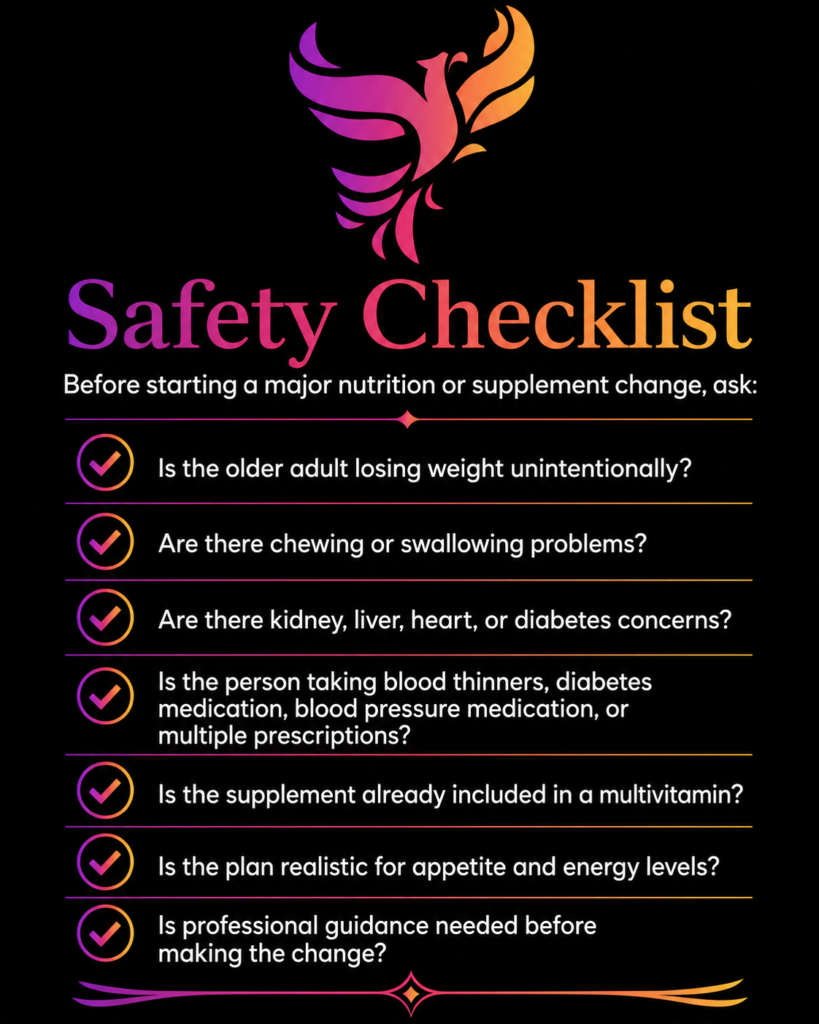
For readers who need personalized support beyond general nutrition education, Geronutrition partners with TeleGeriatric.com to connect older adults, caregivers, and families with specialized geriatric nutrition consultations. This can be a helpful next step when appetite loss, frailty risk, weight changes, chronic disease, supplement safety, or caregiver meal planning requires professional guidance.
Upcoming Trends
Geronutrition is moving from broad healthy aging advice toward more personalized, measurable, and home-based nutrition support. The next stage of aging nutrition will not be built around one generic diet, one supplement category, or one fixed meal plan for every older adult. It will be shaped by precision nutrition, digital health tools, caregiver systems, appetite monitoring, functional aging data, and practical food programs that can be used in real homes.
This shift matters because aging nutrition is not only about calories, vitamins, or “eating healthy.” Older adults may face changing protein needs, reduced appetite, altered digestion, medication interactions, hydration issues, muscle loss, frailty risk, swallowing difficulty, low energy, and inconsistent meal intake. Future geronutrition systems will likely focus less on isolated advice and more on the full picture: what the person eats, what they can tolerate, what they can prepare, what their caregiver can support, and what changes over time.
1. Precision Geronutrition (Geronutrition.com 👑)
Precision geronutrition is one of the most important upcoming trends in healthy aging nutrition. Instead of recommending the same diet pattern to every older adult, precision geronutrition looks at the person’s age, body composition, muscle status, appetite, medication use, chronic conditions, digestion, activity level, lab patterns, food access, caregiver support, and personal goals.
This approach asks a more useful question: what does this specific person need now?
A healthy adult after 50 may need a prevention-focused plan built around protein consistency, fiber, hydration, metabolic health, and long-term muscle preservation. An older adult with low appetite may need smaller meals, high-calorie snacks, soft-chew foods, and appetite-friendly recipes. A frail adult may need a more structured plan focused on protein, energy intake, hydration, and caregiver meal support. A person taking multiple medications may need extra attention to supplement safety, nutrient interactions, and professional guidance.
In the future, precision geronutrition will combine meal history, body weight trends, blood markers, smart scale data, wearable activity signals and caregiver observations to create more responsive nutrition plans. Instead of waiting until weight loss or frailty becomes obvious, these systems may help detect early decline and adjust the plan sooner.
2. Protein-Centered Aging Plans
Protein will remain one of the strongest commercial and clinical topics in geronutrition because it connects directly to muscle preservation, recovery, mobility, balance, immune support, and daily function. As people age, maintaining muscle becomes more difficult, and protein intake often becomes less consistent. Appetite may decline at the same time that the body needs better-quality nutrition.
This is why future senior nutrition programs will likely become more protein-centered. Expect to see more high-protein senior meal plans, protein-rich breakfast guides, soft protein recipes, caregiver-friendly protein snacks, protein powders for older adults, and nutrition programs designed around sarcopenia prevention and frailty support.
The strongest protein-centered geronutrition systems will not only ask, “How much protein is in the diet?” They will also ask:
Can the older adult chew and digest the protein source?
Is protein spread across the day?
Are meals realistic for appetite level?
Is the caregiver able to prepare the food?
Is the person relying too heavily on shakes instead of meals?
Are kidney disease, medications, or other medical concerns present?
The goal will not be to push large portions or oversized supplement servings, but to make protein intake consistent, safe, appetizing and realistic.
3. Appetite and Frailty Nutrition Tools
Appetite loss is one of the most overlooked problems in aging nutrition. Many older adults do not suddenly develop severe malnutrition overnight. The decline often begins quietly: smaller portions, unfinished meals, fewer snacks, reduced interest in food, lower fluid intake, weight change, weakness, or less energy during the day.
Future geronutrition tools will likely focus more heavily on early detection. These may include meal intake logs, appetite scoring tools, weight trend alerts, caregiver dashboards, smart scales, hydration reminders, and simple nutrition screening systems. Instead of only reacting after major weight loss, caregivers and clinicians may be able to notice patterns earlier.
For example, a caregiver dashboard may show that an older parent is regularly skipping dinner, drinking less fluid, or losing weight slowly over several weeks. A smart scale may flag a weight trend. A meal log may show that protein intake is consistently low. A simple appetite tracker may reveal that the person eats better in the morning than at night.
These tools can help turn vague concerns into visible patterns. That is important because geronutrition is most effective when small problems are addressed before they become larger problems.
4. AI-Assisted Senior Meal Planning
AI-assisted meal planning will likely become a major part of future geronutrition. Instead of giving every older adult the same recipe list, AI tools may help build meal plans around appetite, chewing ability, budget, cooking skill, cultural food preferences, medical restrictions, protein goals, grocery access, and caregiver availability.
For older adults, this could make nutrition planning less overwhelming. For caregivers, it could reduce the daily burden of deciding what to cook. For clinicians and coaches, it could help translate nutrition guidance into simple meal patterns that patients can actually follow.
A strong AI geronutrition system might suggest:
High-protein soft meals for low appetite days
Low-sodium senior meals for heart health support
Diabetic-friendly meal patterns for older adults
Mediterranean-style recipes for healthy aging
Easy grocery lists for caregivers
Texture-modified meal ideas
Hydration prompts and snack reminders
Protein distribution across breakfast, lunch, dinner, and snacks
The important difference is that AI should support human judgment, not replace it. Older adults with medical conditions, swallowing problems, rapid weight loss, kidney disease, uncontrolled diabetes, medication changes or frailty still need appropriate professional oversight. The best future systems will combine automation with safety checks.
5. Senior-Friendly Supplement Design
Supplements for older adults will likely become more targeted, easier to use, and more transparent. Many current supplement products are built for younger wellness buyers, gym users, or general adult health. Older adults often need something different: lower pill burden, easier swallowing, clearer labeling, safer dosing, fewer unnecessary ingredient stacks, and formulas that make practical sense.
Future healthy aging supplements may focus more on:
Protein support for older adults
Vitamin D and bone health support
Omega-3 products with clearer dosage guidance
Creatine products positioned for muscle and function
Collagen products with realistic claims
Electrolyte or hydration support for selected users
Multinutrient formulas with reduced duplication risk
Powders, liquids, gummies, or smaller capsules for easier use
The most important commercial shift will be trust. Older adults and caregivers do not only need attractive supplement labels. They need clear use cases, transparent ingredient amounts, safety explanations, medication cautions, and realistic expectations.
Geronutrition recognizes supplements as supportive tools, not miracle solutions. A supplement should help fill a defined gap or support a specific plan. It should not replace meals, medical care, protein-rich foods, hydration or caregiver meal support.
6. Food-as-Care Programs
The future of geronutrition is not only supplements. Food-as-care programs may become one of the most important areas in senior wellness, caregiver support, and longevity nutrition.
Food-as-care means using meals, recipes, grocery systems, and nutrition programs as part of an aging support strategy. This may include medically informed meal planning, high-protein senior meals, appetite-friendly recipes, soft-chew meals, post-hospital recovery nutrition, caregiver grocery lists, batch cooking guides, and condition-aware meal programs.
This trend is especially important because food is where daily nutrition actually happens. A person can read about longevity science for hours, but the real outcome depends on breakfast, lunch, dinner, snacks, hydration, grocery access, cooking ability, and appetite.
Future geronutrition programs may become more structured around common senior needs, such as:
Sarcopenia support
Frailty prevention
Appetite loss
Post-hospital recovery
Diabetes-friendly eating
Heart-healthy senior meals
Kidney-conscious meal planning
Dysphagia and soft-food support
Caregiver meal preparation
Budget-friendly senior nutrition
Families want practical systems: what to buy, what to cook, how to serve it, how to adjust portions and how to repeat the plan without stress.
7. Home-Based Nutrition Monitoring
As more aging care moves into the home, nutrition will become part of remote senior wellness routines. Weight trends, appetite notes, meal completion, hydration reminders, grocery lists, and caregiver updates may become more connected with home-based care systems.
This does not mean every older adult will need advanced technology. In many homes, a simple checklist may be enough. But for higher-risk adults, digital tools may help caregivers notice problems earlier.
Home-based nutrition monitoring may include:
Smart scales that track weight trends
Meal completion logs
Hydration reminders
Appetite notes
Protein intake trackers
Digital grocery lists
Caregiver dashboards
Medication and meal timing reminders
Remote dietitian or clinician updates
Wearable data connected to activity and recovery
Nutrition will become one part of a larger picture that includes movement, sleep, medication, hydration, frailty risk and functional independence.
8. Wearables and Functional Nutrition Tracking
Wearables are usually discussed in terms of steps, heart rate, sleep, or exercise. In geronutrition, their future value may come from connecting food patterns to function.
For example, if an older adult has lower activity, poor sleep, reduced strength, or slower recovery, nutrition may be part of the explanation. Wearable data cannot diagnose nutrition problems by itself, but it can provide useful clues. When combined with meal logs, weight trends, appetite notes, and caregiver observations, it may help identify patterns that would otherwise be missed.
Future geronutrition systems may use wearable data to ask better questions:
Is low energy related to poor meal intake?
Did activity drop after appetite declined?
Is hydration affecting daily function?
Is protein intake consistent on more active days?
Are poor sleep and low appetite happening together?
Are weight changes linked with reduced movement?
The goal is not to make aging nutrition more complicated, it is to connect nutrition with real-life function.
9. Smart Kitchens and Caregiver Grocery Systems
Smart kitchens may become more relevant for older adults and caregivers. This does not only mean futuristic appliances. It may also include practical systems such as digital pantry tracking, automatic grocery lists, meal reminders, recipe suggestions, caregiver shopping templates, and food inventory tools.
For caregivers, grocery organization is often one of the hardest parts of senior nutrition. They may need to plan meals around appetite, chewing ability, medical restrictions, budget, food preferences, and time. Smart grocery systems can reduce this burden by making the food environment more predictable.
A caregiver-friendly geronutrition system might suggest:
A weekly protein checklist
Soft-food grocery staples
High-calorie snack options
Hydration-friendly foods
Low-sodium pantry items
Easy breakfast rotations
Freezer meals for low-energy days
Foods to keep available when appetite drops
The better the grocery system, the easier it becomes to follow the nutrition plan.
10. Microbiome, Digestion, and Tolerance-Based Nutrition
Digestive comfort will likely become a larger part of geronutrition. Older adults may experience changes in appetite, bowel regularity, chewing, swallowing, reflux, medication tolerance, and food sensitivity. A plan that looks nutritious may still fail if it causes discomfort or is difficult to digest.
Future geronutrition content and products pay more attention to tolerance-based nutrition. This means matching food choices not only to nutrients, but also to how the person feels after eating.
Important areas may include:
Fiber tolerance
Constipation support
Hydration and bowel regularity
Fermented foods when appropriate
Protein digestibility
Meal size and reflux
Texture modification
Medication-related digestive changes
Prebiotic and probiotic product claims
Digestive health products often attract exaggerated claims. Geronutrition keeps the focus on practical, safe, and evidence-aware guidance.
11. Digital Nutrition Literacy Tools for Older Adults
Another important trend is nutrition literacy. Older adults and caregivers are often surrounded by confusing advice: anti-aging diets, fasting trends, supplement claims, protein debates, seed oil arguments, detox programs, and social media wellness shortcuts.
Future geronutrition platforms may need digital tools that help readers understand nutrition information more clearly. These tools could include simple calculators, decision trees, meal checklists, supplement safety prompts, glossary pages, risk flags, caregiver guides, and plain-language explanations.
A good nutrition literacy system should help readers answer questions like:
Is this advice meant for older adults?
Does this supplement duplicate something already being taken?
Is this diet too restrictive for someone with low appetite?
Does this recipe provide enough protein?
Is weight loss intentional or concerning?
Should a caregiver or clinician be involved?
Geronutrition helps reader buy carefully, not impulsively.
12. Integrated Longevity and Geriatric Care Platforms
The long-term future of geronutrition may be integration. Nutrition will not sit alone. It may connect with telehealth, remote monitoring, caregiver support, digital care plans, home safety, sleep tracking, medication management, and chronic disease programs.
This is where geronutrition becomes part of a wider healthy aging ecosystem. A senior wellness platform that includes nutrition planning, supplement safety review, appetite monitoring, muscle support, hydration tracking, smart scale data, caregiver updates, and clinician-facing summaries.
The future of geronutrition will not be defined by one superfood, one powder or one diet trend. It will be defined by systems that help older adults eat better, preserve strength, reduce nutrition decline, support caregivers, and connect food decisions with real healthy aging outcomes.
13. Oral Health, Chewing Comfort, and the Oral Microbiome
One emerging area in geronutrition is the connection between oral health and nutrition quality. Older adults may struggle with dry mouth, gum sensitivity, missing teeth, dentures, reduced chewing strength, taste changes, mouth discomfort, or swallowing difficulty. These issues can quietly change food choices. A person may avoid protein foods, raw vegetables, nuts, seeds, whole grains, or textured meals simply because they are difficult to chew or uncomfortable to eat.
This is why future senior nutrition programs may pay closer attention to the mouth as the first step in digestion. Meal plans may need to consider softer textures, moist foods, dental comfort, oral hygiene, saliva support, taste stimulation, and the oral microbiome. For readers exploring how oral bacteria, mouth ecology, and daily oral-care choices may affect broader wellness, Hydropaste’s guide to oral microbiome balance provides a useful supporting resource.
In practical geronutrition, oral health is not separate from food planning. It can shape appetite, meal enjoyment, protein intake, hydration and the ability to follow a healthy aging nutrition plan consistently.
How to Use Geronutrition by Goal, Need and Support Level
Geronutrition is not used the same way by every reader. A healthy adult after 50 may need prevention-focused nutrition guidance, while a caregiver may be trying to solve appetite loss, weight decline, or inconsistent meals for an older parent. A supplement researcher may need safety and product comparison support, while a clinician or senior wellness brand may need structured education that is easy to explain.
The chart below shows the best starting point for each type of visitor, the most practical next step, and the common mistake to avoid when applying geronutrition for healthy aging, senior nutrition, longevity science, meal planning, and supplementation.
| Type | Main Problem | Best Starting Point | Next Step | Avoid This Mistake |
|---|---|---|---|---|
| Healthy adult after 50 | Wants prevention and longevity | Longevity Science education | Build a protein-forward meal rhythm | Buying supplements before fixing meals |
| Older adult living independently | Energy, strength, meal consistency | Geronutrition plan | Track protein, fluids, and appetite | Skipping meals due to low appetite |
| Caregiver | Parent eating less or losing weight | Meal intake and appetite review | Use senior recipes and grocery templates | Forcing large meals |
| Supplement researcher | Wants product guidance | Geronutrition supplements | Compare need, dose, safety, duplication | Stacking multiple products |
| Clinician or coach | Needs patient-friendly education | Tools and resources | Use trackers and structured explanations | Giving generic advice |
| Senior wellness brand | Needs content structure | Homepage and Longevity Science | Connect education to programs and products | Overpromising outcomes |
How to Use Geronutrition.com in the Right Order
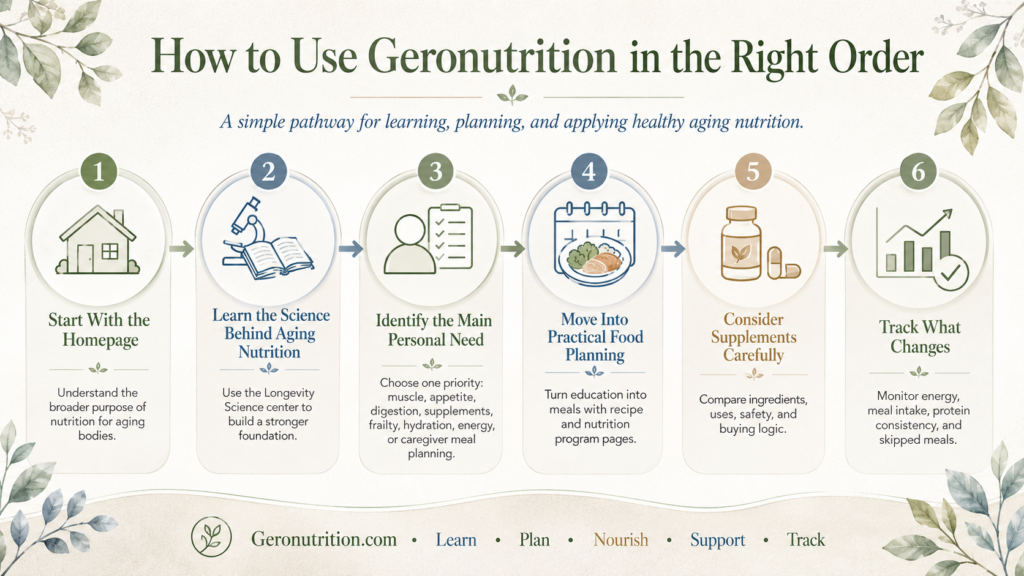
Geronutrition works best when it is used as a structured pathway, not as a random collection of articles, recipes, supplement ideas, and healthy aging tips. Many readers arrive with one urgent concern: low appetite, muscle loss, fatigue, weight change, poor meal consistency, supplement confusion, or the need to support an older parent. The right approach is to move from understanding to personalization, then from planning to daily action.
A reader should move through Geronutrition.com in this order.
1. Start With the Homepage
The homepage is the best starting point because it explains the wider purpose of Geronutrition: nutrition for aging bodies. This is different from general wellness advice. After midlife, the body may respond differently to protein, calories, hydration, digestion, vitamin status, inflammation, appetite signals, and muscle-preserving nutrition.
The homepage gives readers a clear overview of the main areas of the site, including longevity science, healthy aging supplements, senior meal planning, nutrition programs, caregiver meal support, and practical tools. It helps visitors understand whether they need education, recipes, supplement guidance, clinical-style checklists, or a more complete geronutrition plan.
This first step is especially useful for beginners, caregivers, adult children, and older adults who know something has changed but are not sure where to begin.
2. Learn the Science Behind Aging Nutrition
After the homepage, the next step is the Longevity Science center. This section explains why nutrition needs change with age and why older adults often require a more targeted approach than younger adults.
Aging can affect muscle mass, appetite, digestion, nutrient absorption, hydration patterns, metabolic health, immune resilience, inflammation, and recovery after illness. Longevity nutrition is not only about living longer; it is about supporting strength, independence, energy, mobility, and better daily function.
This is where readers build the foundation before comparing supplements, choosing recipes, or following a nutrition program. Without this step, it is easy to chase isolated solutions: one powder for muscle, one vitamin for energy, one diet trend for longevity, or one recipe list for every situation. Geronutrition starts by explaining the “why” behind food choices, protein timing, micronutrient needs, hydration, and healthy aging nutrition.
3. Identify the Main Personal Need
Once the science is clear, the reader should choose one main need first. Trying to fix everything at the same time usually leads to confusion and poor follow-through.
The most common geronutrition needs include muscle support, appetite loss, frailty prevention, low energy, digestion changes, hydration, weight maintenance, supplement safety, blood sugar-friendly meals, heart-healthy eating, post-hospital recovery, and caregiver meal planning.
For example, a healthy adult after 50 may start with prevention, protein consistency, and longevity nutrition. An older adult living independently may need help with meal rhythm, hydration, and strength-supporting foods. A caregiver may need appetite-friendly meals, grocery templates, and ways to support a parent who is eating less. A supplement researcher may need ingredient comparison, dosage awareness, safety checks, and guidance on avoiding product overlap.
Choosing the main need makes the rest of the site easier to use. It turns a broad topic into a practical path.
4. Move Into Practical Food Planning
After the main need is identified, the next step is food planning. This is where geronutrition becomes daily behavior.
The recipe and nutrition program pages help readers move from information to meals. Instead of only reading about protein, fiber, hydration, anti-inflammatory eating, or senior nutrition, visitors can begin applying those ideas through breakfast options, lunch patterns, dinner plans, soft-chew meals, high-protein recipes, Mediterranean-style meals, caregiver grocery lists, and structured nutrition programs.
This stage is important because food is the foundation of geronutrition. Supplements may help in selected situations, but the daily pattern of meals usually matters more. Protein distribution, meal timing, hydration habits, nutrient-dense snacks, and appetite-friendly portions can make a major difference for older adults who struggle with skipped meals, low intake, or inconsistent eating.
For caregivers, this section can also reduce decision fatigue. Instead of asking “What should I cook today?” every day, the goal is to create a repeatable system: simple meals, reliable grocery lists, flexible textures, and realistic portions that match the older adult’s appetite and health needs.
5. Consider Supplements Carefully
Supplements should come after the food plan, not before it. This is one of the most important principles of Geronutrition.com.
The supplement pages are designed to help readers compare ingredients, understand use cases, review safety concerns, and think more clearly about buying decisions. Common areas may include protein powders for seniors, vitamin D, omega-3, creatine, collagen, calcium, magnesium, B vitamins, and other healthy aging supplements. The goal is not to encourage unnecessary supplement stacking. The goal is to help readers understand when a supplement may support a specific need and when it may be unnecessary, duplicated, poorly timed, or risky.
A supplement should support the geronutrition plan, not become the plan. For example, protein powder may help someone who cannot meet protein needs through meals alone, but it should not replace balanced eating. Vitamin D may be relevant for some adults, but it should be considered alongside diet, sunlight exposure, medical history, and professional guidance. Multiple products with overlapping ingredients can also increase the risk of excessive intake, especially for older adults taking medications or managing chronic conditions.
This step is especially important for caregivers, frail adults, medication users, and readers comparing commercial products.
6. Track What Changes
The final step is tracking. A geronutrition plan should not be judged by how complicated it looks. It should be judged by whether it helps.
Readers can use tools, checklists, meal logs, protein trackers, hydration checks, appetite notes, grocery templates, and simple weekly reviews to monitor progress. The most useful signs are often practical: fewer skipped meals, steadier energy, better protein consistency, improved hydration, more stable appetite, easier grocery planning, and more confidence around daily food choices.
Tracking also helps readers avoid overreacting. A single low-appetite day does not mean the entire plan has failed. A supplement does not need to be added every time energy changes. A recipe does not need to be perfect to be useful. The goal is to notice patterns over time and make small, realistic adjustments.
For older adults, caregivers, clinicians, coaches, and senior wellness brands, this final step turns geronutrition into a repeatable system. Learn the science, identify the need, plan the meals, consider supplements carefully, and track what actually changes. That order keeps geronutrition practical, safe, and focused on real healthy aging outcomes.
Common Mistakes When Using Geronutrition
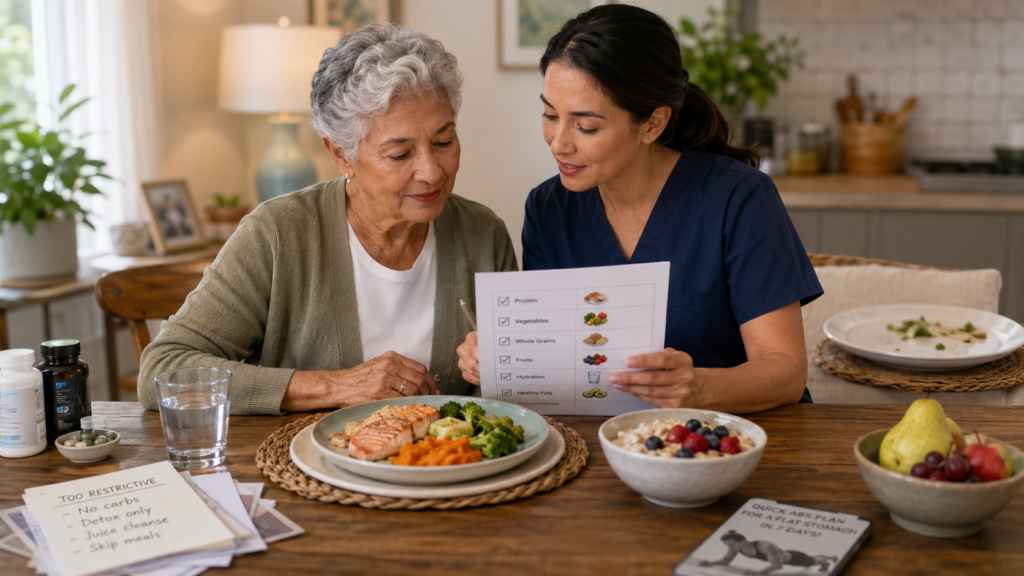
Geronutrition becomes most useful when it is treated as a practical aging nutrition system, not as a quick diet trend, supplement shopping list, or one-size-fits-all wellness routine. Many readers make the same mistakes when they first begin exploring nutrition for older adults: they focus too much on products, copy advice designed for younger bodies, ignore appetite changes, or build a plan that no one in the household can realistically follow.
Avoiding these mistakes helps make geronutrition safer, more practical, and more effective for healthy aging, senior meal planning, caregiver support, muscle preservation, energy, hydration, appetite, and long-term nutrition consistency.
Mistake 1: Treating Geronutrition Like a Diet
Geronutrition is not a short-term diet. It is an aging support strategy.
Most diets are built around restriction. They often focus on eating less, cutting calories, avoiding certain foods, losing weight, or following a fixed set of rules. That approach may work for some younger adults with specific goals, but it can become risky or ineffective when applied carelessly to older adults.
Geronutrition focuses on function. The main question is not simply, “How can I eat less?” The better question is, “How can food support strength, appetite, mobility, digestion, immune resilience, hydration, energy, and independence as the body ages?”
For many older adults, the priority is not aggressive restriction. The priority may be maintaining muscle, preventing unintentional weight loss, improving protein intake, supporting bone health, reducing skipped meals, keeping digestion comfortable, and making meals easier to eat. A geronutrition plan may include nutrient-dense foods, protein-forward meals, softer textures, smaller portions, higher-calorie snacks, hydration support, and meal timing strategies.
The mistake is thinking geronutrition is another diet plan. It is better understood as a long-term nutrition framework for aging bodies.
Mistake 2: Starting With Supplements Too Early
Many readers jump straight to supplement pages because supplements feel simple. A product can be bought quickly. A habit takes time to build.
This is one of the most common mistakes in healthy aging nutrition. Protein powders, vitamin D, omega-3, creatine, collagen, magnesium, calcium, B vitamins, and other supplements may have a role in certain situations, but they cannot repair an incomplete food pattern on their own.
If an older adult is skipping meals, eating very little protein, drinking too little fluid, losing weight, or struggling with appetite, supplements should not be the first move. The first move is to understand the daily pattern: what is being eaten, how often meals are missed, whether chewing or swallowing is difficult, whether grocery access is a problem, whether medications affect appetite, and whether the person is getting enough protein, calories, fluids, and essential nutrients.
A supplement should support the geronutrition plan, not replace it. For example, a protein shake may help when meals are too small, but it should be used with a wider strategy for breakfast, lunch, dinner, snacks, hydration, and caregiver meal support. A vitamin or mineral supplement may be useful when there is a confirmed gap or a clear reason to consider it, but stacking multiple products without checking overlap can create unnecessary risk.
The better order is: food pattern first, personal need second, safety review third, supplement comparison last.
Mistake 3: Ignoring Appetite
A nutrition plan that ignores appetite will fail.
Appetite changes are common in older adults, and they can happen for many reasons. Taste changes, dental problems, dry mouth, medications, loneliness, grief, digestion issues, reduced activity, illness, pain, low mood, and difficulty cooking can all affect how much a person wants to eat. A plan that looks perfect on paper may still fail if the older adult cannot finish the meals, does not enjoy the food, or feels overwhelmed by large portions.
Geronutrition must work with appetite, not against it.
Some older adults may do better with smaller meals throughout the day instead of three large plates. Others may need softer foods, stronger flavors, moist textures, high-protein snacks, calorie-dense additions, soups, smoothies, eggs, yogurt, tender proteins, easy grains, or simple ready-to-eat options. Caregivers may also need flexible meal ideas for days when appetite is low.
The goal is not to force large meals. Forcing food can create stress and resistance, especially when a caregiver is involved. A better approach is to create more eating opportunities, improve meal comfort, increase nutrient density, and make food easier to accept.
For example, instead of asking an older adult to finish a large dinner, it may be more realistic to offer a smaller protein-rich meal, a nourishing snack later, and fluids throughout the day. In geronutrition, consistency often matters more than meal size.
Mistake 4: Using Young-Adult Nutrition Advice for Older Bodies
Nutrition advice designed for younger adults does not always fit older bodies.
Many mainstream wellness messages are built around fat loss, fasting, low-calorie eating, intense exercise, body composition changes, or performance optimization. Those ideas may not address the realities of aging nutrition. Older adults often need more attention to muscle preservation, protein distribution, hydration, bone support, nutrient density, appetite, digestion, medication interactions, and recovery after illness.
A younger adult may be focused on cutting calories. An older adult may need to prevent unintended weight loss. A younger adult may experiment with fasting. An older adult with low appetite may need more regular eating opportunities. A younger adult may be able to recover quickly from a poor eating week. An older adult may lose strength, energy, or weight more quickly when meal intake drops.
This does not mean older adults cannot have weight goals, blood sugar goals, heart health goals, or fitness goals. It means those goals must be handled with more care. A geronutrition plan should consider age-related changes in muscle, metabolism, appetite, digestion, absorption, hydration, and frailty risk.
The mistake is copying general nutrition advice without adjusting it for aging. Geronutrition exists because older adults often need a more targeted approach.
Mistake 5: Not Involving the Caregiver
If a caregiver buys groceries, prepares meals, organizes medications, schedules appointments, or monitors eating, they must be part of the nutrition strategy.
A nutrition plan is only useful if it can be followed in real life. A perfect plan that requires complicated recipes, expensive ingredients, constant cooking, or unrealistic meal timing may collapse quickly when a caregiver is already managing many responsibilities.
Caregiver-friendly geronutrition should be simple, repeatable, and organized. It should include grocery templates, easy meal rotations, protein-rich snack options, hydration reminders, texture adjustments, appetite notes, and practical ways to track what the older adult actually eats. It should also respect the caregiver’s time, budget, cooking ability, and emotional load.
For example, a caregiver may need to know which foods are easy to prepare, which meals can be repeated, which snacks are useful on low-appetite days, and how to notice changes in intake before weight loss becomes more serious. They may also need guidance on when to seek professional advice, especially if there is rapid weight loss, swallowing difficulty, dehydration, confusion, uncontrolled blood sugar, or major medication changes.
The mistake is building a plan only for the older adult without thinking about the person who helps make the plan happen. In many households, geronutrition is not just an individual routine. It is a shared care system.
The Better Way to Use Geronutrition
The best way to use Geronutrition.com is to move in the right order: understand the aging nutrition problem, identify the main personal need, build a food-first plan, consider supplements carefully, involve the caregiver when needed, and track what changes over time.
A good geronutrition strategy does not need to be complicated. It needs to be realistic, safe, consistent, and matched to the person’s actual life. For older adults and caregivers, the most meaningful progress often comes from simple improvements: fewer skipped meals, better protein intake, steadier hydration, improved appetite support, easier grocery planning, and more confidence around daily eating.
The Right Way to Use Geronutrition
The right way to use geronutrition is to begin with the body, not the product.
Ask what is changing. Is appetite lower? Is muscle harder to maintain? Are meals becoming smaller? Is the person relying on the same few foods? Are supplements being added without a clear reason? Is the caregiver guessing instead of tracking?
Geronutrition.com is built to help readers answer those questions with structure. Use the homepage for orientation, the Longevity Science center for education, supplement pages for careful product decisions, recipe and program pages for daily meals, and tools for tracking what matters.
Aging nutrition is not about chasing youth. It is about protecting function, independence, nourishment, and dignity through smarter daily choices.
FAQs
What is the best way to use geronutrition for healthy aging after 50?
The best way to use geronutrition after 50 is to start with function, not restriction. Look at muscle strength, appetite, energy, digestion, weight stability, hydration, and meal consistency. Then build meals around protein, fiber, colorful plants, healthy fats, and enough calories to support daily life.
After that foundation is in place, supplements can be considered for specific gaps. A protein powder, vitamin D supplement, B12 support, omega-3 product, or creatine discussion may be useful for some adults, but only when the need is clear. Geronutrition works best when food, habits, and targeted support are aligned.
How do I create a geronutrition plan for an elderly parent?
Start by observing the parent’s actual eating pattern for several days. Note breakfast habits, skipped meals, fluid intake, chewing difficulty, food preferences, weight changes, fatigue, and whether protein appears at each meal.
Then create a simple plan with three priorities: a reliable protein source, easy-to-eat meals, and caregiver-friendly preparation. For example, breakfast may include eggs or yogurt, lunch may include soup with lentils or soft chicken, and dinner may include fish, beans, tofu, or minced meat with vegetables and grains. If appetite is low, use smaller meals with higher nutrient density instead of forcing large portions.
Are geronutrition supplements necessary for older adults?
Geronutrition supplements are not automatically necessary for every older adult. They are most useful when they address a defined gap, such as low protein intake, low vitamin D status, limited B12 intake, poor appetite, or difficulty meeting nutrition needs through meals alone.
The risk is using supplements as a replacement for food or stacking multiple products without reviewing doses and interactions. A safer approach is to start with meals, identify what remains difficult, then choose targeted support with professional guidance when needed.
What is the difference between geronutrition and longevity nutrition?
Longevity nutrition is often broad. It may focus on lifespan, metabolism, cellular aging, inflammation, and disease prevention. Geronutrition is more specific to aging bodies and older adults. It includes longevity goals but also considers appetite loss, muscle decline, frailty risk, chewing difficulty, hydration, medication interactions, caregiver routines, and meal practicality.
In simple terms, longevity nutrition asks, “What supports a longer healthy life?” Geronutrition asks, “What does this aging person need to stay nourished, strong, functional, and supported now?”
How can caregivers use geronutrition for senior meal planning?
Caregivers can use geronutrition by turning nutrition into a repeatable weekly system. Start with a protein list, a soft-food list, a grocery template, and a few reliable meals the older adult enjoys. Then track appetite, meal completion, fluids, and weight changes.
A caregiver does not need to prepare complicated meals. In many homes, the most effective system is a small rotation of dependable options: high-protein breakfast, nourishing soup, soft dinner, fortified snack, and hydration reminders. Consistency matters more than variety when the person is at risk of under-eating.
People Also Ask
How does geronutrition work for muscle loss in older adults?
Geronutrition supports muscle by improving the nutrition environment around aging muscle. That usually means enough total protein, better protein distribution across meals, sufficient calories, vitamin D awareness, hydration, and pairing nutrition with safe strength activity when possible.
Muscle loss is not only a gym issue. It affects walking, balance, recovery, stair climbing, independence, and fall risk. A geronutrition strategy gives protein a clear role in daily meals instead of treating it as an optional side item.
Can geronutrition help with appetite loss in elderly adults?
Geronutrition can help with appetite loss by changing meal size, texture, timing, flavor, and nutrient density. Instead of pushing large meals, the strategy may use smaller portions, softer foods, calorie-dense additions, soups, smoothies, fortified snacks, and caregiver-supported meal routines.
Appetite loss should not be ignored, especially if it is new or linked with weight loss, fatigue, swallowing difficulty, medication changes, depression, dental problems, or illness. In those cases, professional evaluation is important.
What foods are most important in a geronutrition diet?
The most important foods in a geronutrition diet are protein-rich foods, fiber-rich plants, healthy fats, fluids, and nutrient-dense meals that the older adult can actually eat. Eggs, yogurt, fish, lentils, beans, tofu, poultry, cottage cheese, oats, vegetables, berries, olive oil, nuts, seeds, soups, and soft stews can all fit.
The best food list depends on chewing ability, appetite, medical conditions, culture, budget, and cooking support. Geronutrition is not about copying one ideal plate. It is about building the most useful plate for that person.
Is geronutrition useful for people who already eat healthy?
Yes. Many people eat “healthy” but still miss aging-specific needs. A person may eat vegetables and avoid processed food but still consume too little protein, too few calories, not enough fluids, or meals that are poorly timed for muscle support.
Geronutrition refines healthy eating for the aging body. It asks whether the diet supports strength, recovery, digestion, cognition, mobility, and daily function — not just whether the foods look healthy.
When should someone seek professional help for geronutrition?
Professional help is important when there is unintended weight loss, frailty, repeated falls, swallowing difficulty, poor appetite, chronic disease, kidney or liver concerns, diabetes, heart disease, medication complexity, or confusion about supplements.
A healthcare professional or dietitian can help personalize nutrition safely. Geronutrition.com can educate and organize the decision-making process, but it should not replace individualized medical care when clinical risk is present.