
Updated July, 2026.
Amazon Affiliate Disclosure
Geronutrition may earn a commission when readers purchase through qualifying affiliate links, including Amazon links. This does not change the editorial evaluation of any supplement category, ingredient, or product direction. Bone health supplementation should be matched to diet, lab results, medications, kidney health, fracture risk, and clinical guidance.
Best Supplements for Bone Health After 50
At Geronutrition, bone health is treated as a living system, not a calcium-only problem. The search for the best supplements for bone health usually begins with one simple worry: “Are my bones getting weaker?” But the real answer is rarely one bottle.
Bone strength depends on mineral supply, vitamin status, protein intake, hormones, muscle function, physical loading, digestion, medication history, inflammation, and fall risk. A person can take calcium every day and still have weak bones if vitamin D is low. Another person can take a premium vitamin d3 k2 supplement but still miss the structural minerals and protein needed to support bone matrix. Someone else may have good intake on paper, but poor absorption, low appetite, limited sunlight, or digestive changes may quietly reduce the actual benefit.
That is why this bone-support page is built as a decision guide. It covers calcium, vitamin d3 and k2, magnesium, protein, collagen, bone density support, osteoporosis supplement planning, joint-support overlap, safety considerations, supplement timing, and upcoming bone-health technology.
For readers exploring the wider supplement system for healthy aging, this page connects naturally with the main longevity supplements hub, because bone strength is not only about avoiding fractures. It is about mobility, independence, posture, confidence, and the ability to keep moving through later life.
Quick Picks: Jump to the Bone Health Section You Need
Use this guide as a bone-support roadmap. Start with the section that matches your concern, then move through the full page for a more complete supplement strategy.
| Quick Pick | Best For | Jump Link |
|---|---|---|
| Bone-support basics | Understanding what bone supplements are for | What Are Bone-Support Supplements For? |
| Senior bone health | Adults over 50, postmenopause, low intake, frailty risk | Who Needs Bone Health Supplements for Seniors? |
| Main outcomes | Bone density, mineral balance, muscle support, fall-risk nutrition | Benefits of Bone-Support Supplements |
| Core nutrient stack | Calcium, D3, K2, magnesium, protein, collagen | The Bone Nutrition Stack |
| D3 + K2 explanation | People searching for vitamin d3 k2 | Vitamin D3 K2: Why This Pair Gets So Much Attention |
| Comparison search | People wanting to know the difference between vitamin D3 K2 and calcium | Vitamin D3 K2 vs Calcium |
| Calcium choices | Calcium citrate, carbonate, hydroxyapatite, food-first planning | Best Calcium Supplements for Bone Health |
| Magnesium and collagen | Bone matrix, muscle function, joint comfort | Magnesium, Collagen, Protein, and Joint Support |
| Bone density strategy | Osteopenia, osteoporosis support, DEXA-style thinking | Bone Density Support and Osteoporosis Supplements |
| Product selection | How to compare supplement labels | How to Choose a K2 D3 Vitamin Supplement or Bone Formula |
| Timing and routine | When to take calcium, D3, K2, magnesium, protein | Supplement Timing Chart |
| Commercial comparison | Which supplement category fits which need | Bone-Support Supplement Comparison Table |
| Common errors | Overdosing, ignoring protein, relying on one pill | Common Bone Supplement Mistakes |
| New science | Testing, personalization, bone-tech, supplement delivery | Upcoming Trends & Latest Tech |
| Editorial wrap-up | Practical strategy for long-term bone health | Editorial Insights |
| FAQs | Important questions | Frequently Asked Questions |
| PAA | People Also Ask answers | People Also Ask |
What Are Bone-Support Supplements For?
Bone-support supplements are designed to help the body maintain the nutrients involved in bone structure, mineralization, remodeling, muscle coordination, and connective-tissue support.
They are not a substitute for medical treatment for osteoporosis, fracture recovery, endocrine disease, kidney disease, malabsorption, or medication-related bone loss. Their real role is nutritional support. The best use is to fill gaps, strengthen a food-first plan, support healthy aging, and help people make their bone-care routine more consistent.
Think of bone like a renovated building. Calcium is part of the stone and concrete. Vitamin D helps bring materials into the construction site. Vitamin K2 is often discussed for its role in directing calcium-related proteins. Magnesium supports the machinery that keeps mineral metabolism working. Protein provides the scaffolding. Collagen contributes to the flexible matrix that gives bone some resilience instead of making it purely brittle.
A bone supplement routine may be used for:
| Bone-Support Goal | Nutrients Often Considered | Practical Meaning |
|---|---|---|
| Maintain bone mineral density | Calcium, vitamin D3, magnesium, vitamin K2 | Supports the mineral side of bone health |
| Support calcium absorption | Vitamin D3 | Helps the body absorb and regulate calcium |
| Support calcium utilization | Vitamin K2, magnesium | Often included in formulas targeting mineral direction and metabolism |
| Support bone matrix | Protein, collagen peptides, vitamin C | Helps the soft framework that minerals attach to |
| Support muscle-bone connection | Protein, vitamin D, magnesium | Important because muscles load bones and help reduce fall risk |
| Support joint comfort | Collagen, omega-3s, vitamin C, minerals | Useful when bone support overlaps with mobility and joints |
For a deeper calcium-specific page, see calcium for seniors.
Who Needs Bone Health Supplements for Seniors?
Bone health supplements are most relevant when there is a realistic nutrient gap, higher bone-risk profile, or increased need for structured support. Not every person needs a full formula. Some need vitamin D only. Some need dietary calcium. Some need more protein. Some need medical osteoporosis care, not just supplements.
The strongest candidates usually fall into one or more of these groups.
Adults Over 50 With Low Calcium Intake
Many older adults eat less than they used to. Appetite changes, dental issues, lactose intolerance, budget pressure, reduced cooking, digestive discomfort, and medication schedules can all reduce calcium-rich food intake.
If a person rarely eats yogurt, milk, fortified plant milk, calcium-set tofu, sardines with bones, leafy greens, or calcium-fortified foods, a calcium gap becomes more likely. In that case, calcium supplements for bone health may be useful, especially when taken in the right amount rather than excessive doses.
Postmenopausal Women
After menopause, bone loss can accelerate because estrogen decline affects bone remodeling. This does not mean every postmenopausal woman should automatically take a large supplement stack. It means bone nutrition deserves more careful attention.
A practical plan may include vitamin D status, calcium intake review, protein adequacy, resistance training, and screening when appropriate.
Older Adults With Limited Sun Exposure
Vitamin D is difficult to obtain from food alone. People who spend most of the day indoors, cover most skin outdoors, live in low-sun climates, have darker skin, or avoid sunlight due to skin concerns may have lower vitamin D status.
This is where vitamin d3 and k2 benefits become a common search interest. Vitamin D3 is often used to support vitamin D status, while K2 is included in many bone formulas because of its relationship with vitamin K-dependent proteins.
For a focused deep dive, see vitamin D3 and K2 for bone health.
People With Osteopenia or Osteoporosis Risk
A person with low bone density needs more than a supplement label. The plan should involve medical evaluation, DEXA interpretation, fall-risk assessment, medication review, strength training, protein intake, calcium and vitamin D adequacy, and fracture-risk context.
Supplements can support nutritional foundations, but they do not replace prescription osteoporosis therapy when clinically indicated.
For a condition-specific nutrition page, see osteoporosis supplements.
People With Low Protein Intake or Muscle Loss
Bone and muscle age together. Weak muscle reduces mechanical loading on bone, worsens balance, and raises fall risk. A person trying to protect bone density while eating too little protein is missing a major part of the system.
That is why bone support often belongs beside best protein powder guidance, especially for older adults who struggle to meet protein needs through meals alone.
People Taking Medications That May Affect Bone Health
Some medications may influence bone density, mineral status, appetite, digestion, or fall risk. Examples may include long-term corticosteroids, some acid-reducing medications, certain anticonvulsants, some endocrine therapies, and medications that increase dizziness or falls.
This is not a reason to stop medication. It is a reason to ask a clinician whether bone monitoring, vitamin D testing, calcium intake review, or osteoporosis screening is appropriate.
Benefits of Bone-Support Supplements
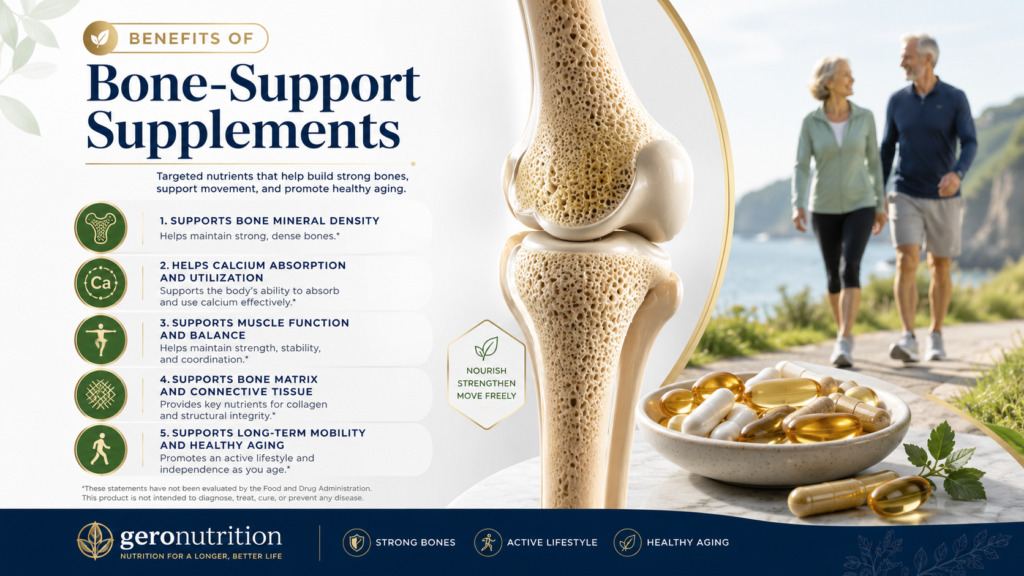
The benefits of bone-support supplements depend on whether the person actually needs the nutrient, whether the dose is appropriate, and whether the rest of the bone-health system is in place.
A supplement is most useful when it solves a real bottleneck. Calcium helps most when calcium intake is low. Vitamin D helps most when vitamin D status or intake is inadequate. Protein helps most when daily protein intake is too low. Magnesium helps when intake is poor or muscle function is part of the concern.
Benefit 1: Supports Bone Mineral Density Maintenance
Bone density is partly shaped by mineral availability. Calcium is the most recognized mineral, but bone mineralization also depends on vitamin D, magnesium, phosphorus balance, vitamin K status, and overall dietary quality.
A good bone-support supplement routine does not flood the body with minerals. It fills the missing part of the pattern.
Benefit 2: Helps Improve Calcium Absorption Strategy
Vitamin D3 is important because calcium intake alone does not guarantee calcium absorption. If vitamin D status is low, the body may not use calcium efficiently.
This is the practical reason many formulas combine calcium with vitamin D3. It is also why some people search vitamin D3 K2 vs calcium: they sense that calcium alone may not be enough.
Benefit 3: Supports Muscle Function and Balance Nutrition
Vitamin D, magnesium, and protein are not only bone nutrients. They also influence muscle function. In aging, this matters because many fractures happen after falls. A nutrition plan that supports both bone and muscle is more useful than a bone-only formula.
Benefit 4: Supports Bone Matrix, Not Just Bone Minerals
Bone is not only mineral. It has a collagen-rich matrix. Minerals give hardness; the matrix contributes structure and resilience. Collagen peptides are often marketed for joints, but they also belong in the broader conversation about connective tissue and musculoskeletal aging.
For a dedicated joint-focused page, see collagen for joint support.
Benefit 5: Makes a Bone-Care Routine Easier to Follow
A carefully chosen supplement can make consistency easier. Many people do not fail because they lack motivation. They fail because the routine is confusing. Should calcium be taken with meals? Should magnesium be taken at night? Is D3 better with fat? Is K2 safe with medications?
A well-structured routine reduces friction, especially for older adults managing multiple supplements.
The Bone Nutrition Stack
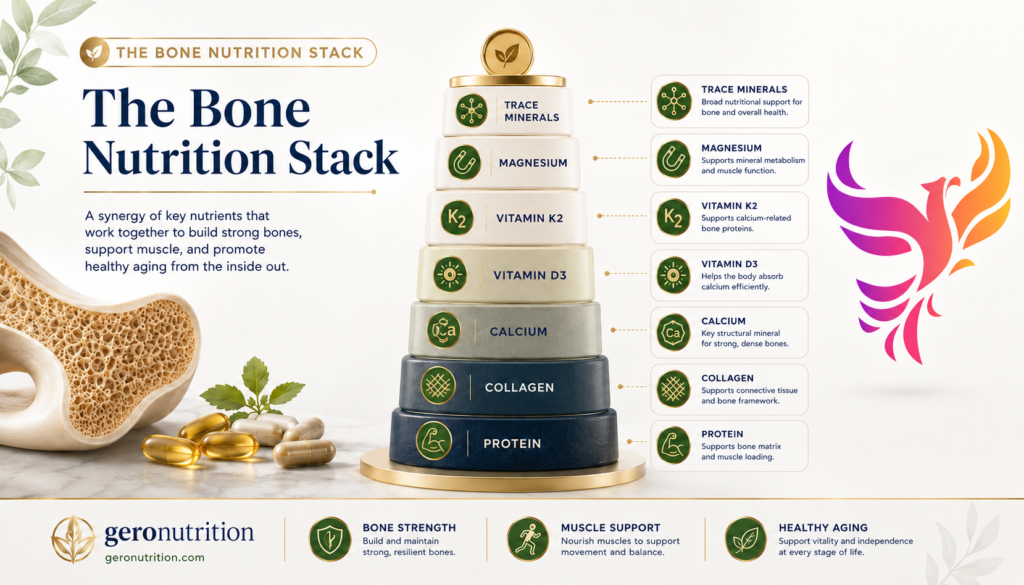
The strongest bone-support approach is not “calcium versus everything else.” It is a stack of complementary nutrients.
The Core Bone-Support Stack
| Nutrient | Main Bone Role | Best Use Case | Common Mistake |
|---|---|---|---|
| Calcium | Structural mineral in bone | Low dietary calcium intake | Taking high doses without calculating food intake |
| Vitamin D3 | Supports calcium absorption and vitamin D status | Low sun exposure, low vitamin D intake, older age | Taking high doses without testing or medical guidance |
| Vitamin K2 | Supports vitamin K-dependent calcium-related proteins | Often paired with D3 in bone formulas | Ignoring warfarin or anticoagulant interactions |
| Magnesium | Supports vitamin D metabolism, muscle, mineral balance | Low magnesium intake, muscle cramps, low-quality diets | Expecting magnesium alone to fix bone density |
| Protein | Supports bone matrix and muscle loading | Frailty risk, low appetite, sarcopenia risk | Focusing on minerals while under-eating protein |
| Collagen peptides | Supports connective tissue matrix | Joint comfort, low protein variety, musculoskeletal aging | Treating collagen as complete protein |
| Vitamin C | Supports collagen formation | Low fruit and vegetable intake | Taking collagen but ignoring vitamin C-rich foods |
| Zinc, boron, manganese | Trace mineral support | Comprehensive formulas, low diet quality | Assuming trace minerals replace calcium, D, protein |
The Geronutrition Bone-Support Framework
A strong bone supplement plan should answer five questions:
| Framework Step | Key Question | Why It Matters |
|---|---|---|
| Intake | What is missing from food? | Supplements should fill gaps, not duplicate excess |
| Absorption | Can the body absorb and use it? | Digestion, vitamin D status, medications, age matter |
| Remodeling | Is bone turnover being medically assessed? | Osteoporosis risk needs clinical context |
| Loading | Are muscles challenging the bones? | Resistance training helps signal bone maintenance |
| Safety | Could this interact with medication or kidney health? | Calcium, D3, K2, and minerals are not risk-free for everyone |
Vitamin D3 K2: Why This Pair Gets So Much Attention
The phrase vitamin d3 k2 has become one of the most searched combinations in bone health supplements. The interest is understandable. Vitamin D3 and vitamin K2 are often presented as a partnership: D3 supports calcium absorption, while K2 is discussed for its role in activating proteins involved in calcium handling.
A d3 k2 vitamin product usually combines vitamin D3 with vitamin K2, often in the MK-7 form. Some products add calcium, magnesium, boron, zinc, or trace minerals. Others keep the formula simple with D3 and K2 only.
Vitamin D3 and K2 Benefits
The most relevant vitamin d3 and k2 benefits for bone-support readers include:
| Benefit Area | Vitamin D3 Role | Vitamin K2 Role | Practical Meaning |
|---|---|---|---|
| Calcium absorption | Helps absorb calcium from the gut | Does not replace calcium absorption | D3 helps make calcium intake more useful |
| Bone mineralization | Supports mineral balance | Supports vitamin K-dependent bone proteins | They work in different parts of the bone system |
| Supplement simplicity | Easy to dose in drops, capsules, softgels | Often paired with D3 in one product | Useful for people who want fewer bottles |
| Healthy aging | Supports bone and muscle function | Supports calcium-related protein activation | Often included in longevity supplement routines |
K2 Forms: MK-4 vs MK-7
Vitamin K2 supplements often come as MK-4 or MK-7.
| Form | Common Supplement Pattern | Practical Notes |
|---|---|---|
| MK-4 | Often used in shorter-acting forms | May require more frequent dosing depending on product design |
| MK-7 | Common in once-daily K2 supplements | Popular because of longer activity and convenient dosing |
| K1 | Found mainly in leafy greens | More associated with clotting function, but still part of total vitamin K nutrition |
Many bone formulas use MK-7 because it fits a once-daily routine. However, K2 should be handled carefully by anyone taking warfarin or similar anticoagulant therapy. Vitamin K can interfere with medication management, so clinician guidance matters.
Vitamin D3 K2 vs Calcium
The comparison vitamin D3 K2 vs calcium is slightly misleading because these nutrients do different jobs. Calcium is a building material. D3 helps the body absorb and regulate that material. K2 supports proteins involved in calcium use. Asking which is “better” is like asking whether bricks, delivery trucks, or construction supervisors matter more when building a house.
They matter together, but not always in the same dose or priority.
Vitamin D3 K2 vs Calcium: Practical Comparison
| Question | Calcium | Vitamin D3 K2 |
|---|---|---|
| What is it? | Mineral used heavily in bone structure | Vitamins involved in calcium absorption and calcium-related protein activity |
| What problem does it solve best? | Low calcium intake | Low vitamin D status or desire for D3 + K2 support |
| Does it build bone alone? | Not reliably by itself | Not without adequate minerals and protein |
| Best for | People with low calcium from food | People with low sun exposure, low vitamin D intake, or D3/K2 formula preference |
| Main caution | Too much calcium can cause constipation or kidney stone risk in some people | K2 can interact with warfarin; D3 can be excessive at high doses |
| Best routine | Calculate food calcium first, supplement the gap | Take with a meal containing fat, follow dose guidance |
Which Should Come First?
The better question is: what is missing?
| Situation | Better First Step |
|---|---|
| Low dairy, no fortified foods, low calcium diet | Review calcium intake and consider calcium support |
| Low sun exposure, low vitamin D blood level, older age | Review vitamin D3 intake and testing |
| Already taking calcium but not D3 | Consider whether vitamin D status is adequate |
| Taking D3 but eating little calcium | Improve calcium-rich foods or consider calcium supplement gap-fill |
| Taking warfarin | Do not add K2 without medical guidance |
| History of kidney stones | Discuss calcium supplement type and dose with clinician |
Best Calcium Supplements for Bone Health
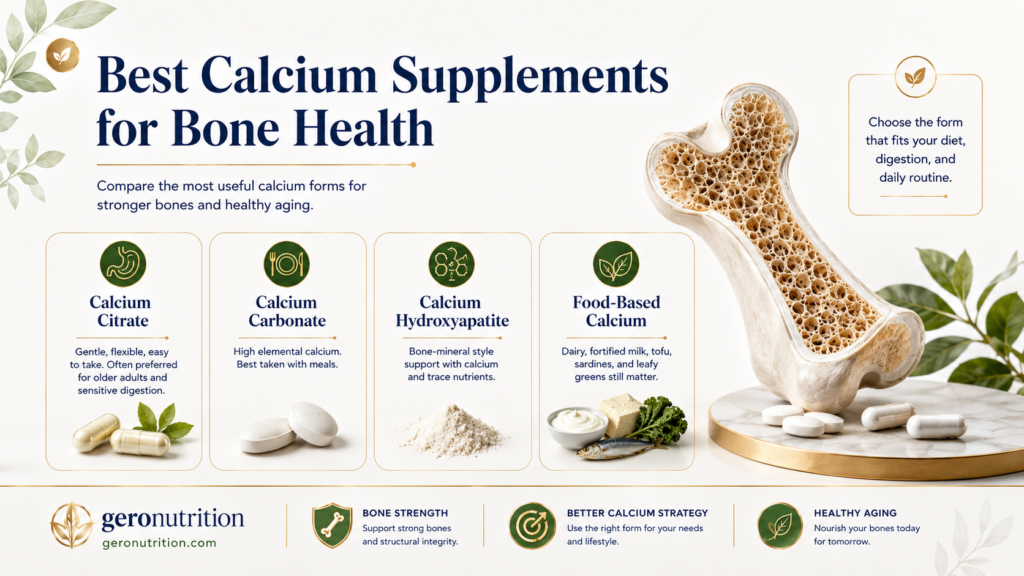
The best calcium supplements are not always the strongest tablets. The right choice depends on stomach acid, digestive tolerance, pill size, dose per serving, diet, constipation tendency, medications, and whether the person prefers tablets, capsules, powders, chews, or liquids.
The goal is not maximum calcium. The goal is the right total calcium intake from food plus supplements.
Calcium Citrate
Calcium citrate is often easier to take because it can be used with or without meals and may be better tolerated by people with lower stomach acid. It is often a good direction for older adults, people using acid-reducing medications, or those who dislike heavy chalky tablets.
| Calcium Citrate Strength | Practical Meaning |
|---|---|
| Can be taken without a large meal | Useful for inconsistent appetite |
| Often gentler | May suit people with digestion concerns |
| Lower elemental calcium per pill than carbonate | May require more capsules/tablets |
Calcium Carbonate
Calcium carbonate provides more elemental calcium per tablet and is often less expensive. It is best taken with meals because stomach acid helps absorption.
| Calcium Carbonate Strength | Practical Meaning |
|---|---|
| High elemental calcium | Fewer tablets may be needed |
| Often budget-friendly | Good for simple calcium gap-filling |
| Best with meals | Less ideal for people with poor meal consistency |
| Can feel constipating | Hydration, fiber, and dose splitting matter |
Calcium Hydroxyapatite
Calcium hydroxyapatite is derived from bone mineral sources and often includes calcium with phosphorus and trace minerals. It is marketed as a more “bone-like” mineral form. Some individuals prefer it because it feels more complete than plain calcium carbonate or citrate.
| Calcium Hydroxyapatite Feature | Practical Meaning |
|---|---|
| Bone-mineral style formula | Often positioned as premium bone support |
| May include phosphorus and trace minerals | Useful when someone wants a broader mineral profile |
| Usually more expensive | Best for targeted use, not casual over-supplementing |
Food-First Calcium Sources
Supplements work best when paired with food. A bone-support plan should identify food calcium before adding pills.
| Food | Bone-Support Advantage |
|---|---|
| Greek yogurt | Calcium plus protein |
| Milk or fortified plant milk | Calcium, often vitamin D fortified |
| Calcium-set tofu | Calcium plus plant protein |
| Sardines with bones | Calcium, vitamin D, omega-3s, protein |
| Kale and bok choy | Calcium plus vitamin K |
| Fortified oatmeal or cereal | Useful for low-appetite mornings |
| Cheese | Calcium dense, but sodium and saturated fat vary |
For a deeper guide on calcium form, dose splitting, and senior-friendly options, visit calcium for seniors.
Magnesium, Collagen, Protein and Joint Support
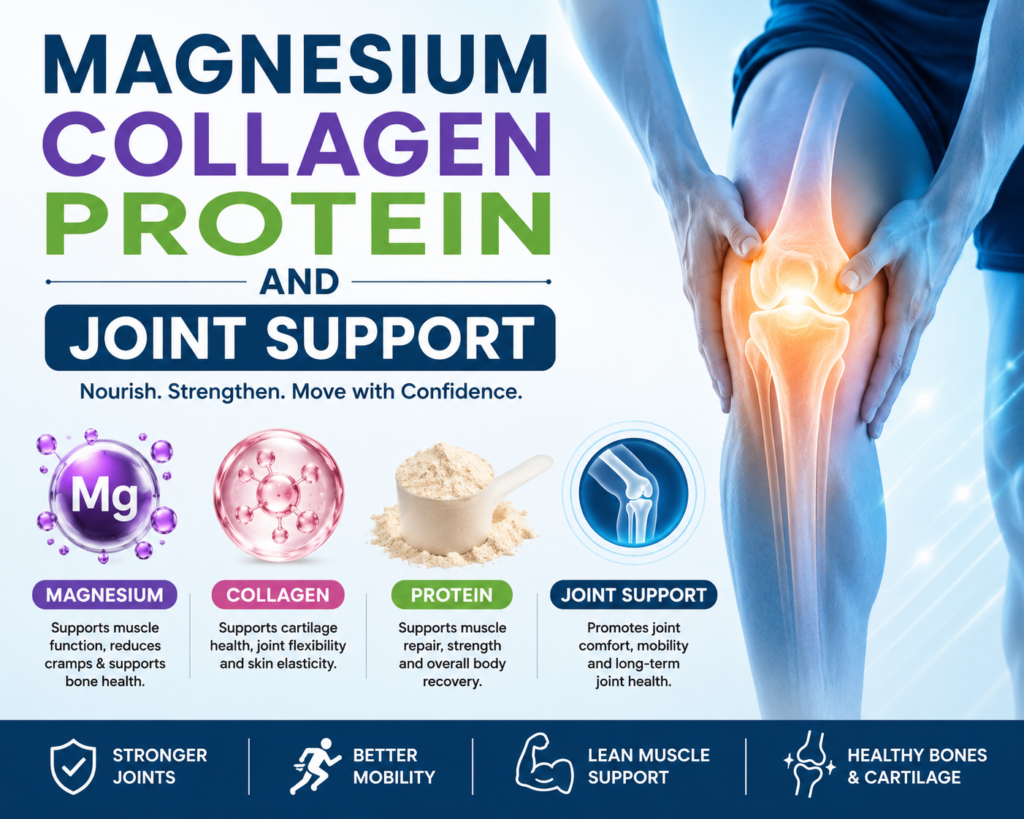
Bone health becomes more practical when it is treated as musculoskeletal health. Bones need minerals, but they also respond to muscle, movement, connective tissue, and balance.
Magnesium for Elderly Adults
Magnesium supports hundreds of biochemical processes, including muscle function, energy metabolism, and vitamin D metabolism, as part of broader Metabolic Support Supplements. For bone health, magnesium is not the headline mineral, but it is part of the background machinery.
Older adults may have low magnesium intake because of low vegetable intake, low nuts and seeds, reduced appetite, digestive issues, or medication patterns.
Common magnesium types include:
| Magnesium Type | Often Used For | Notes |
|---|---|---|
| Magnesium glycinate | Gentle daily support | Often preferred for tolerability |
| Magnesium citrate | Magnesium support plus bowel regularity | May loosen stools |
| Magnesium oxide | Budget magnesium | Lower absorption for many people |
| Magnesium malate | Energy and muscle-focused formulas | Often used in daytime formulas |
| Magnesium threonate | Brain-focused positioning | More often used in cognitive formulas than bone formulas |
For a dedicated cognition-focused guide, see cognitive supplements guide.
Collagen and Bone Matrix
Collagen is often discussed for skin and joints, but it also matters in the architecture of bone. Bone mineral sits in a protein-rich matrix. That matrix helps give bone structure and resilience.
Collagen peptides are not complete protein because they lack enough of certain essential amino acids. They should not replace high-quality dietary protein. They can, however, complement a protein-rich diet when joint comfort, connective tissue, and musculoskeletal aging are part of the concern.
Protein and Bone Strength
Protein is sometimes overlooked in bone health because calcium dominates the conversation. That is a mistake. Bone is living tissue, and muscle is one of the strongest signals that bones need to remain strong.
Low protein intake can worsen frailty, reduce muscle loading on bone, and make recovery harder after illness. A person with low bone density and low muscle mass needs a bone-and-muscle strategy, not just calcium tablets.
This is why bone support should connect with protein guidance, especially for older adults considering best protein powder options.
Joint-Support Supplements for Seniors
Joint comfort affects bone health indirectly. If knees, hips, ankles, or back pain reduce movement, bones receive less mechanical loading. Less movement can mean weaker muscles, poorer balance, and reduced confidence.
Joint-support supplements may include collagen, omega-3s, glucosamine, chondroitin, turmeric, Boswellia, MSM, or hyaluronic acid. These are not the same as bone density supplements, but they can support mobility routines when used appropriately.
For a dedicated mobility page, see joint-support supplements for seniors.
Bone Density Support and Osteoporosis Supplements
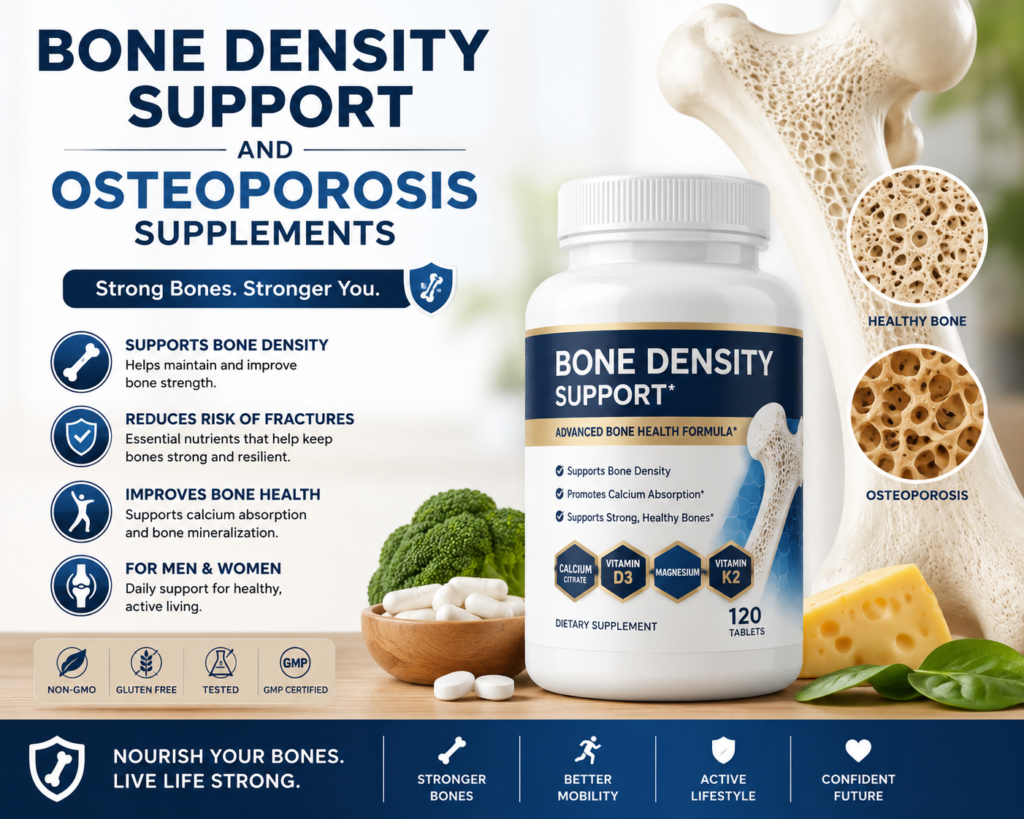
Bone density support is a higher-intent topic than general bone wellness. It often reflects concern after a DEXA scan, height loss, fracture, family history, menopause, steroid use, or a clinician mentioning osteopenia or osteoporosis.
A supplement page must be honest here: osteoporosis is not solved by a supplement stack. Nutrition supports the foundation, but medical treatment may be needed depending on fracture risk and bone density results.
Bone Density Support: What Supplements Can and Cannot Do
| Supplement Role | Can Help With | Cannot Replace |
|---|---|---|
| Calcium | Filling intake gaps | Prescription osteoporosis therapy when needed |
| Vitamin D3 | Supporting vitamin D status and calcium absorption | Full fracture-risk management |
| Vitamin K2 | Supporting vitamin K-dependent proteins | Anticoagulant-safe planning without clinician input |
| Magnesium | Muscle and mineral metabolism support | DEXA monitoring |
| Protein | Muscle, bone matrix, recovery | Resistance exercise |
| Collagen | Connective tissue support | Complete protein intake |
| Trace minerals | Comprehensive nutrition support | Medical diagnosis |
The DEXA-Aware Supplement Strategy
A person using supplements for bone density should think in layers:
| Layer | Question | Action |
|---|---|---|
| Test | Has bone density been measured? | Ask about DEXA scan if risk is high |
| Intake | Is calcium intake adequate? | Calculate food calcium first |
| Status | Is vitamin D low? | Consider blood testing |
| Strength | Is muscle being trained? | Add resistance and balance work where safe |
| Medication | Are bone-impacting drugs involved? | Review with clinician |
| Fall risk | Are vision, balance, footwear, home hazards addressed? | Reduce fracture triggers |
| Follow-up | Is progress tracked? | Recheck clinically, not by symptoms alone |
For a deeper discussion of nutrition and measurement, visit bone density support.
How to Choose a K2 D3 Vitamin Supplement or Bone Formula
A k2 d3 vitamin supplement can be useful, but the label deserves careful reading. Many formulas look impressive because they include long nutrient lists. More ingredients do not always mean a better supplement.
The best supplement is the one that matches the person’s actual gap, can be taken consistently, avoids unnecessary megadoses, and does not conflict with medication or medical history.
Label Checklist
| Label Feature | What to Look For | Why It Matters |
|---|---|---|
| Vitamin D3 amount | Usually listed in IU and mcg | Avoid accidental high daily totals |
| Vitamin K2 form | MK-7 or MK-4 | Helps compare product design |
| Calcium amount | Elemental calcium per serving | Large tablets may still not provide what people assume |
| Magnesium type | Glycinate, citrate, malate, oxide | Tolerance and absorption differ |
| Serving size | 1, 2, 3, or 4 capsules/tablets | A “high dose” may require multiple pills |
| Third-party testing | USP, NSF, Informed Choice, ISO-style lab testing, or COA | Helps quality confidence |
| Allergen notes | Dairy, soy, gelatin, shellfish, gluten | Important for older adults with dietary restrictions |
| Medication cautions | Especially vitamin K and anticoagulants | Prevents unsafe combinations |
Formula Types
| Formula Type | Best For | Watch-Out |
|---|---|---|
| D3 + K2 only | People who already get enough calcium | Does not replace calcium intake |
| Calcium + D3 | Simple bone mineral support | May lack K2, magnesium, trace minerals |
| Calcium + D3 + K2 | Common bone formula | Must check medication cautions |
| Bone mineral complex | People wanting broad mineral support | Can become overbuilt and expensive |
| Collagen + minerals | Bone and joint overlap | Collagen is not complete protein |
| Senior multivitamin with bone nutrients | Simplicity | May underdose calcium or magnesium |
Senior-Friendly Usability
The best supplement on paper can fail in daily life if it is hard to swallow, causes constipation, requires too many capsules, or conflicts with medication timing.
A senior-friendly bone formula should be:
| Feature | Why It Matters |
|---|---|
| Moderate dose | Reduces unnecessary excess |
| Easy serving size | Improves consistency |
| Clear label | Helps caregiver review |
| Split-dose friendly | Calcium is often better tolerated in divided doses |
| Gentle form | Important for digestion |
| Medication-aware | Prevents unsafe supplement layering |
Supplement Timing Chart
Timing is not magic, but it can improve tolerance and consistency.
| Supplement | Better Timing | Why |
|---|---|---|
| Vitamin D3 | With a meal containing fat | Fat-soluble vitamin |
| Vitamin K2 | With a meal containing fat | Fat-soluble vitamin |
| Calcium carbonate | With meals | Stomach acid helps absorption |
| Calcium citrate | With or without meals | More flexible |
| Magnesium glycinate | Evening or split dose | May be calming for some people |
| Magnesium citrate | Earlier in day or evening depending bowel effect | Can loosen stools |
| Collagen peptides | Anytime, often with breakfast or drink | Easy routine habit |
| Protein powder | Breakfast, post-exercise, or low-protein meal | Supports muscle-bone system |
| Multivitamin | With food | Better tolerance |
Example Bone-Support Day
| Time | Routine Example | Notes |
|---|---|---|
| Breakfast | Protein-rich meal plus vitamin D3 K2 | Works well with eggs, yogurt, fortified foods, olive oil, avocado, or nuts |
| Lunch | Calcium-rich food | Yogurt, fortified plant milk, tofu, sardines, greens |
| Dinner | Calcium supplement if needed | Best only if diet is short |
| Evening | Magnesium glycinate | Useful if tolerated and not conflicting with medications |
| Training days | Protein after resistance exercise | Bone responds to muscle loading |
Bone-Support Supplement Comparison Table
This comparison is designed for commercial intent while keeping the decision medically sensible.
| Category | Best For | Strong Sign | Weak Sign | Best Internal Next Step |
|---|---|---|---|---|
| Vitamin D3 K2 | Low sun exposure, D3/K2 interest, simple routine | Clear D3 dose, MK-7 K2, fat-soluble instructions | Mega-dose D3 without guidance | Read vitamin D3 and K2 for bone health |
| Calcium citrate | Older adults, low stomach acid, flexible timing | Moderate elemental calcium, split-dose friendly | Oversized tablets, constipation | Read calcium for seniors |
| Calcium carbonate | Budget calcium support | Taken with meals, simple label | Taken on empty stomach, digestive discomfort | Compare calcium types |
| Bone mineral complex | Broad bone nutrient support | Includes D3, magnesium, trace minerals | Too many nutrients at high doses | Use label checklist |
| Magnesium glycinate | Muscle and mineral metabolism support | Gentle form, reasonable dose | Promises bone rebuilding alone | Read magnesium for elderly adults |
| Collagen peptides | Joint and connective tissue support | Paired with protein-rich diet | Used as only protein source | Read collagen for joint support |
| Protein powder | Low appetite, muscle loss, frailty risk | Complete protein, leucine-rich profile | High sugar, low protein per serving | Read best protein powder |
Common Bone Supplement Mistakes
Mistake 1: Taking Calcium Without Measuring the Gap
Calcium should not be treated like a general wellness booster. It is a gap-filling nutrient. The first step is estimating food calcium. A person eating yogurt, cheese, fortified milk, tofu, and leafy greens may not need the same dose as someone eating very little calcium.
Mistake 2: Taking Vitamin D3 Without Thinking About Dose
Vitamin D3 is useful, but it is fat-soluble and can accumulate when taken excessively. Many people stack D3 from multiple products: multivitamin, bone formula, immune supplement, and separate D3 drops. The label total matters.
Mistake 3: Adding K2 While Taking Warfarin
Vitamin K can interfere with warfarin therapy. Anyone taking warfarin should not add K2 casually. The issue is not that vitamin K is “bad.” The issue is consistency and medication management.
Mistake 4: Ignoring Protein
A mineral-only bone plan can be incomplete. Bones respond to muscle. Muscle needs protein. For older adults, low protein intake can quietly undermine the entire bone-support routine.
Mistake 5: Assuming Joint Supplements Are Bone Density Supplements
Collagen, glucosamine, chondroitin, and hyaluronic acid may support joint comfort for some individuals, but they are not the same as calcium, vitamin D, magnesium, or osteoporosis nutrition support.
Mistake 6: Waiting for Symptoms
Bone loss is often silent until a fracture occurs. Pain is not a reliable early warning system for low bone density. Risk-based screening matters.
Mistake 7: Not Connecting Bone and Brain Health
Falls are not only a bone issue. Balance, cognition, reaction time, sleep, vision, medications, and muscle strength all matter. This is why healthy aging supplement planning may also include brain supplements when the wider goal is independence, alertness, and safe mobility.
Upcoming Trends and Latest Tech
Bone-support supplements are moving from generic “calcium plus D” products toward more personalized, test-guided, and musculoskeletal formulas.
Trend 1: DEXA-Aware Supplement Planning
More individuals are beginning to connect supplement routines with bone density scans. Instead of taking a generic formula indefinitely, the smarter pattern is to use DEXA results, fracture history, age, menopause status, vitamin D levels, and diet assessment to guide supplement choices.
Trend 2: Vitamin D Testing and Personalized Dosing
The question “how much vitamin d3 and k2 should i take daily” is becoming more common because people understand that one dose does not fit everyone. The future of vitamin D supplementation is likely to become more test-aware, especially for older adults, people with obesity, darker skin, limited sunlight, malabsorption, or osteoporosis risk.
Trend 3: Better K2 Formulas
K2 is becoming more common in bone formulas, especially MK-7. Expect more products to highlight K2 form, source, stability, and pairing with D3. The next level will be clearer labeling around medication cautions, especially for anticoagulant users.
Trend 4: Bone + Muscle Combination Products
The strongest healthy-aging formulas will likely move beyond bone-only positioning. Bone, muscle, and joint health are linked. Future formulas may combine D3, K2, magnesium, collagen peptides, amino acids, creatine, and trace minerals for mobility-focused aging.
Trend 5: Wearables and Fall-Risk Nutrition
Bone health is not only density. A person fractures when bone vulnerability meets impact. Wearables that track gait speed, balance changes, activity levels, sleep, and fall risk may eventually pair with nutrition plans. This could make bone-support supplementation more practical and less guess-based.
Trend 6: Microbiome and Mineral Absorption
Gut health may become more important in bone nutrition conversations. Absorption, inflammation, protein digestion, and mineral handling are all influenced by the digestive environment. Expect future bone formulas to pay more attention to prebiotics, probiotics, digestive tolerance, and mineral bioavailability.
Trend 7: Smarter Senior-Friendly Delivery
Large tablets are a major barrier. More bone-support products will likely appear as powders, liquids, gummies with lower sugar, dissolvable sticks, mini-capsules, and combined daily packs. The winning products for older adults will not only be clinically sensible; they will be easy to take.
Frequently Asked Questions
How much vitamin d3 and k2 should i take daily?
The right daily amount depends on age, sun exposure, blood vitamin D level, diet, medications, kidney health, and whether the person has osteopenia, osteoporosis, or malabsorption concerns.
For many adults, vitamin D recommendations often fall in the general range of 600 to 800 IU daily, while many older adults are commonly advised to consider 800 to 1,000 IU daily depending on clinical context. Some individuals require more under medical supervision, especially when blood levels are low. The adult upper safety limit is commonly treated as 4,000 IU per day from all sources unless a clinician is supervising higher-dose correction.
Vitamin K2 is different because there is no standard K2-only daily requirement in the same way people discuss vitamin D. Many K2 D3 vitamin supplement products use MK-7 in the 90 to 180 mcg range, but the right choice depends heavily on medication status. Anyone taking warfarin should not add K2 without clinician guidance.
| Nutrient | Common Daily Pattern | Key Caution |
|---|---|---|
| Vitamin D3 | Often 600–1,000 IU for general adult and older adult support, depending on context | Avoid stacking multiple high-D3 products |
| Vitamin K2 MK-7 | Often 90–180 mcg in supplements | Avoid unsupervised use with warfarin |
| Calcium | Usually based on total food + supplement intake | Do not exceed needs; kidney stone history matters |
| Magnesium | Often adjusted by diet and tolerance | Can affect bowels and interact with some medications |
A practical approach is to calculate calcium from food, check all supplement labels for hidden D3, discuss vitamin D testing when risk is high, and avoid adding K2 if anticoagulant medication is involved.
What is vitamin d3 and k2 good for?
Vitamin D3 and K2 are commonly used together for bone-support routines. Vitamin D3 helps support vitamin D status and calcium absorption. Vitamin K2 supports vitamin K-dependent proteins involved in calcium-related biology. Together, they are often positioned as a smarter calcium-support pair than taking calcium alone.
They are not magic bone builders. Their value depends on the rest of the plan: adequate calcium, enough protein, magnesium intake, resistance exercise, fall-risk reduction, and medical screening when needed.
| Search Intent | Practical Answer |
|---|---|
| Bone health | D3 supports calcium absorption; K2 supports calcium-related proteins |
| Senior nutrition | Useful when sunlight is low and bone risk is higher |
| Calcium support | Helps calcium become part of a broader strategy |
| Longevity supplement routine | Fits mobility, strength, and healthy-aging planning |
| Safety | K2 needs caution with warfarin; D3 dose should be monitored |
Vitamin d3 and k2 benefits are strongest when they solve an actual gap instead of being taken blindly.
Para que sirve la vitamina d3 y k2?
“Para que sirve la vitamina d3 y k2” means “what is vitamin D3 and K2 used for?” In bone health, vitamin D3 helps the body absorb and regulate calcium, while vitamin K2 is commonly used in supplements to support calcium-related proteins involved in bone and vascular biology.
In simple English: vitamin D3 helps bring calcium into the system, while K2 is often discussed for helping the body use calcium more appropriately. This does not mean K2 replaces calcium, magnesium, protein, or medical osteoporosis care.
| Spanish Search Meaning | English Explanation |
|---|---|
| Vitamina D3 | Helps support vitamin D status and calcium absorption |
| Vitamina K2 | Supports vitamin K-dependent calcium-related proteins |
| D3 + K2 | Often used together in bone-support supplements |
| Precaución | K2 may not be appropriate with warfarin or certain anticoagulant plans |
For an English-language Geronutrition page, this question can capture bilingual search intent while still educating readers safely.
What happens if you take vitamin d3 without k2?
Taking vitamin D3 without K2 is common. Many people take D3 alone, especially when the main goal is correcting low vitamin D status. D3 does not automatically require K2 in every person.
The concern behind this question is calcium handling. Vitamin D3 can increase calcium absorption, while K2 is involved in vitamin K-dependent proteins related to calcium use. Some supplement brands use this to suggest that D3 should always be paired with K2. The reality is more nuanced.
| Situation | D3 Without K2: Practical View |
|---|---|
| Short-term vitamin D correction | Often done clinically without K2 |
| Normal diet rich in leafy greens and vitamin K foods | K status may already be adequate |
| Taking warfarin | K2 may be inappropriate unless clinician-managed |
| Taking high-dose D3 long term | Needs medical oversight, with or without K2 |
| Bone health formula planning | D3 + K2 may be useful when appropriate |
The bigger risk is not simply “D3 without K2.” The bigger risk is taking excessive D3, ignoring calcium intake, ignoring medications, and never checking vitamin D status when risk is high.
Are calcium supplements for bone health better than food calcium?
Food calcium is usually the better foundation because calcium-rich foods often bring other useful nutrients with them. Yogurt provides calcium plus protein. Sardines provide calcium, vitamin D, omega-3s, and protein. Fortified plant milk may provide calcium and vitamin D. Leafy greens can provide calcium, magnesium, potassium, and vitamin K.
Calcium supplements are useful when food intake does not reliably meet needs. They should be used to fill the gap, not to replace a nutrient-dense diet.
| Calcium Source | Advantage | Limitation |
|---|---|---|
| Food calcium | Comes with protein and other nutrients | Intake may be inconsistent |
| Calcium citrate | Flexible timing, often senior-friendly | More pills may be needed |
| Calcium carbonate | Budget-friendly, concentrated | Best with meals, may constipate |
| Bone mineral calcium | Broader mineral profile | Often more expensive |
A smart plan starts with a food calcium estimate, then uses supplements only where the diet falls short.
People Also Ask
What are the best supplements for bone health after 50?
The best supplements for bone health after 50 usually include the nutrients most likely to become limiting with age: vitamin D3, calcium when intake is low, magnesium, protein support, and sometimes vitamin K2. Collagen may also be useful when joint comfort and connective tissue support are part of the goal.
The strongest approach is not a single supplement. It is a stack matched to the person.
| Need After 50 | Supplement Direction | Why |
|---|---|---|
| Low calcium intake | Calcium citrate or carbonate | Fills mineral gap |
| Low sun exposure | Vitamin D3 | Supports vitamin D status |
| D3 pairing interest | Vitamin D3 K2 | Supports calcium absorption and K-dependent proteins |
| Low protein intake | Protein powder or high-protein foods | Supports muscle and bone matrix |
| Muscle cramps or low magnesium foods | Magnesium glycinate or citrate | Supports muscle and mineral metabolism |
| Joint discomfort | Collagen or joint-support formula | May support mobility routine |
The best supplement is the one that solves the most important bottleneck without creating unnecessary excess.
Is vitamin D3 K2 better than calcium?
Vitamin D3 K2 is not “better” than calcium because it does a different job. Calcium is a structural mineral. Vitamin D3 supports calcium absorption. Vitamin K2 supports vitamin K-dependent proteins involved in calcium-related processes.
For someone with low calcium intake, D3 K2 without calcium may be incomplete. For someone with adequate calcium intake but low vitamin D status, D3 may matter more than adding extra calcium. For someone taking warfarin, K2 may not be appropriate without medical guidance.
| If This Is the Problem | More Useful Direction |
|---|---|
| Low calcium diet | Calcium intake correction |
| Low vitamin D | Vitamin D3 support |
| Wants D3 plus calcium-use support | D3 K2 formula |
| On warfarin | Avoid K2 unless clinician-managed |
| Osteoporosis diagnosis | Medical plan plus nutrition foundation |
The most accurate answer to vitamin D3 K2 vs calcium is: identify the missing piece first.
What is the best calcium supplement for seniors?
The best calcium supplement for seniors is often calcium citrate when digestion, stomach acid, medication schedules, or meal inconsistency are concerns. Calcium carbonate can also work well for people who tolerate it and take it with meals. Calcium hydroxyapatite may appeal to people who want a broader bone-mineral style formula.
| Calcium Type | Best For Seniors Who | Watch-Out |
|---|---|---|
| Calcium citrate | Need flexible timing or gentler digestion | Lower calcium per pill |
| Calcium carbonate | Want affordable, concentrated calcium | Best with meals; may constipate |
| Calcium hydroxyapatite | Want premium bone-mineral style support | Higher cost |
| Liquid calcium | Struggle with tablets | Check sugar and serving size |
| Chewable calcium | Need easier swallowing | Watch sugar alcohols and additives |
The best choice is not only about absorption. It is about whether the person can take it consistently and safely.
Can bone-support supplements improve bone density?
Bone-support supplements may help maintain or improve bone density when they correct real deficiencies or low intake patterns. For example, calcium plus vitamin D may be useful when intake is inadequate, while protein support may help preserve the muscle-bone system.
However, supplements alone may not be enough for osteopenia or osteoporosis. Bone density is influenced by hormones, age, genetics, medications, resistance exercise, body weight, inflammation, and fracture history.
| Bone Density Factor | Supplement Role |
|---|---|
| Low calcium intake | Calcium support may help fill the gap |
| Low vitamin D | D3 may support absorption and status |
| Low protein | Protein support may help muscle and matrix |
| No resistance training | Supplements cannot replace loading |
| Osteoporosis | Needs clinical management, not only supplements |
Supplements are best viewed as foundation support, not the entire treatment plan.
Should I take bone supplements and brain supplements together?
Bone supplements and brain supplements can be part of the same healthy-aging routine, but they should not be stacked casually. Older adults often take several products at once, and overlapping ingredients can create excessive vitamin D, magnesium, zinc, or other nutrient intake.
The reason bone and brain support overlap is practical: falls often involve balance, attention, sleep, reaction time, vision, medication effects, and muscle strength. A person trying to preserve independence may need both musculoskeletal support and cognitive support.
| Combined Goal | Bone-Support Nutrients | Brain-Support Considerations |
|---|---|---|
| Mobility | Vitamin D, calcium, magnesium, protein | Alertness, balance, sleep |
| Fall-risk nutrition | Protein, D3, magnesium | Cognition, reaction time |
| Healthy aging | D3 K2, minerals, collagen | Omega-3s, B vitamins, magnesium |
| Supplement safety | Avoid excess minerals | Avoid duplicate nutrients |
A combined routine should be reviewed for duplicate doses, medication interactions, and actual need.
Editorial Insights
The best supplements for bone health are not defined by the longest label or the highest dose. They are defined by fit.
A strong bone-support plan asks:
| Editorial Question | Better Answer |
|---|---|
| Is calcium intake low? | Fill the gap with food first, then supplement if needed |
| Is vitamin D status low or uncertain? | Consider testing and appropriate D3 support |
| Is K2 appropriate? | Useful in many formulas, but medication context matters |
| Is protein intake strong enough? | Protect muscle to protect bone |
| Is magnesium intake adequate? | Support the metabolic background of bone and muscle |
| Is the person moving safely? | Bone needs loading, not only nutrients |
| Is osteoporosis risk present? | Use supplements as foundation, not replacement for care |
Bone-support supplements work best when they are part of a bigger healthy-aging system: nutrition, resistance exercise, balance, sunlight strategy, medical screening, fall prevention, and consistent routines.
For readers building a complete healthy-aging plan, return to Geronutrition and connect bone support with protein, cognition, mobility, and longevity nutrition.