
Amazon Affiliate Disclosure
GeroNutrition may participate in affiliate programs, including the Amazon Services LLC Associates Program. This means we may earn a small commission when readers purchase qualifying products through links on our website. This does not increase the cost to the reader. Our editorial approach is designed to prioritize relevance, aging physiology, clinical usefulness, and responsible supplement education rather than promotional pressure.
The GeroNutrition longevity books library is built for readers who want more than scattered advice about healthy aging, supplements, muscle loss, metabolism, and nutrient deficiencies after 50. These downloadable clinical resources organize the science of aging nutrition into clear, practical guides that can be read, saved, revisited, and used as a decision-support companion.
Aging changes the body quietly before it changes daily life visibly. Protein needs shift. Digestion becomes less efficient. Muscle protein synthesis slows. Vitamin D, B12, magnesium, omega-3, calcium, and other nutrient gaps become more common. Metabolism becomes less forgiving. Inflammation can become persistent. The purpose of this e-book hub is to help visitors move from confusion to structure.
For visitors who want clinical tools and downloadable guides, and structured frameworks, this page belongs inside the Tools and Clinical Resources Hub. For readers new to the topic, the best starting point is the GeroNutrition homepage, where the broader mission of nutrition for healthy aging is introduced.
Quick Picks: Jump to the Right GeroNutrition E-book
| Reader Goal | Best Section to Visit | Recommended E-book |
|---|---|---|
| “I want to understand nutrition and aging from the beginning.” | Longevity Science Foundation | Geronutrition: Longevity Science |
| “I want a supplement strategy for adults over 50.” | Precision Supplementation | Precision Supplementation for the Aging Body |
What Is the GeroNutrition E-books Page For?
The GeroNutrition e-books page is a digital library for people who want structured, clinically informed education about nutrition after 50, longevity science, and age-specific supplementation. Instead of reading isolated posts and trying to connect the dots alone, visitors can use these e-books as complete learning pathways.
This page currently highlights two core downloadable guides:
- Geronutrition: Longevity Science
- Precision Supplementation for the Aging Body
Together, they cover the two sides of healthy aging nutrition. The first explains the biological foundation: why nutrition changes with age, how metabolism adapts, what inflammaging means, why sarcopenia matters, and how nutrient absorption shifts over time. The second turns that foundation into a supplement-focused framework: what to consider, how to think about dose timing, where risks appear, and how to match supplementation to aging physiology.
Readers who want a deeper content pathway after downloading may continue into related clusters such as aging and nutrient absorption, sarcopenia and aging, inflammaging explained, and nutrient deficiencies in older adults.
Why E-books Matter in Aging Nutrition
Aging nutrition is not a topic that works well as a single checklist. The body after 50 is not simply an older version of the body at 30. It is a different biological environment.
Muscle becomes more resistant to low protein intake. The gut may absorb certain nutrients less efficiently. Chronic medication use can interfere with nutrient status. Appetite can decline even when nutrient requirements remain high. Bone remodeling changes. Glucose handling shifts. Recovery from illness takes longer. Small deficiencies may not feel dramatic at first, but they can gradually influence strength, cognition, immunity, bone health, and metabolic resilience.
A well-designed aging nutrition guide gives structure to this complexity. It allows the reader to understand how one system influences another. Protein intake is not only about muscle. It also affects mobility, wound healing, immune function, and independence. Vitamin D is not only about bones. It can intersect with muscle performance, fall risk, and immune function. Omega-3 is not only a heart-health topic. It may be part of a wider conversation around inflammation, cognition, and cellular aging.
The purpose of these guides is not to overwhelm the reader with technical language. It is to translate clinical reasoning into a format that feels usable.
Featured E-book 1: Geronutrition: Longevity Science
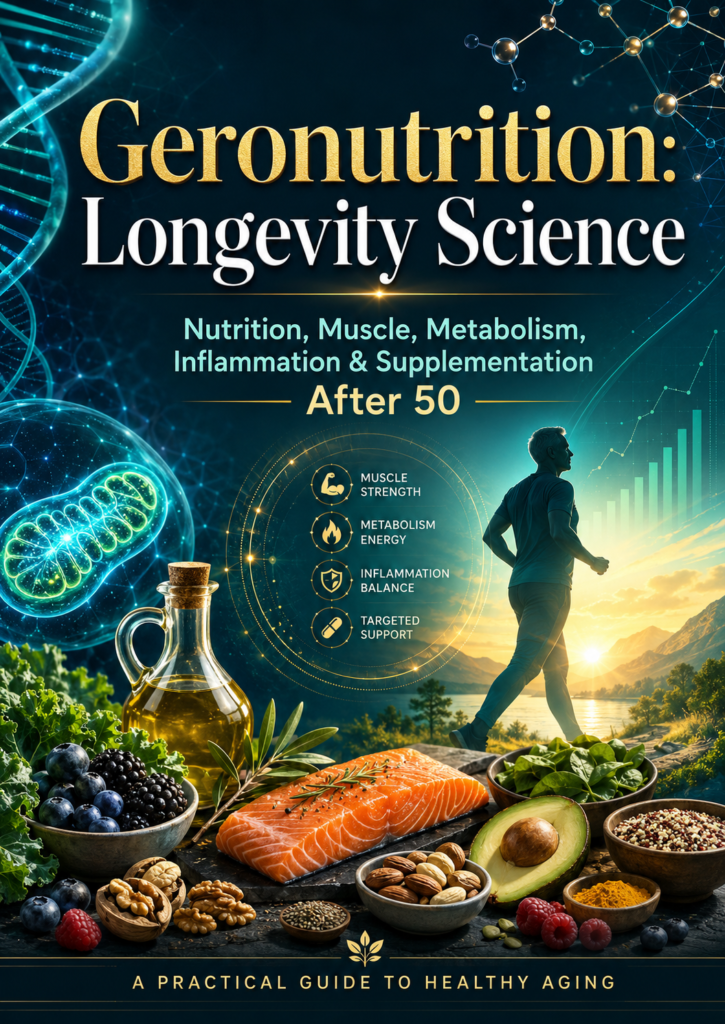
Geronutrition: Longevity Science is the foundational e-book for readers who want to understand the science behind nutrition and aging. It is designed for adults over 50, caregivers, wellness-focused readers, health writers, clinicians-in-training, and anyone building a serious knowledge base around healthy aging.
This longevity science e-book explains how nutrition interacts with biological aging. It does not reduce longevity to a single supplement, diet trend, or miracle ingredient. Instead, it frames healthy aging as a systems-level process involving metabolism, inflammation, mitochondrial function, muscle preservation, nutrient sufficiency, and long-term resilience.
What This Longevity Science E-book Covers
The guide is structured around major questions older adults and caregivers often ask:
- Why does nutrition become more important after 50?
- What changes in digestion and nutrient absorption with age?
- Why does muscle loss accelerate in later life?
- How does inflammaging affect metabolic and cognitive health?
- What is the link between mitochondrial health and aging?
- Why do deficiencies become more common in older adults?
- How can nutrition support independence, energy, and quality of life?
A reader can use this e-book as a starting map before exploring deeper cluster pages such as what is geronutrition, nutrition after 60, and healthy aging nutrition.
Who Needs Geronutrition: Longevity Science?
This e-book is especially useful for:
- Adults over 50 who want a serious nutrition roadmap
- Adults over 60 managing energy decline, muscle loss, or dietary gaps
- Family caregivers supporting aging parents
- Readers researching longevity nutrition science
- Wellness professionals creating education plans
- Health-conscious adults who want prevention-focused guidance before problems appear
This guide is not only for people who already have symptoms. It is also for people who want to understand the aging body early enough to act intelligently.
Benefits of This E-book
The main benefit of Geronutrition: Longevity Science is orientation. It helps readers understand why aging nutrition cannot be separated into isolated topics. Protein, vitamin D, fiber, omega-3, magnesium, hydration, metabolic health, gut function, and inflammation are not separate conversations. They are connected.
The e-book gives readers a framework for asking better questions. Instead of asking only, “What supplement should I take?” the reader begins asking, “What biological need am I trying to support?” That shift matters. It reduces impulsive buying and improves long-term health literacy.
Featured E-book 2: Precision Supplementation for the Aging Body
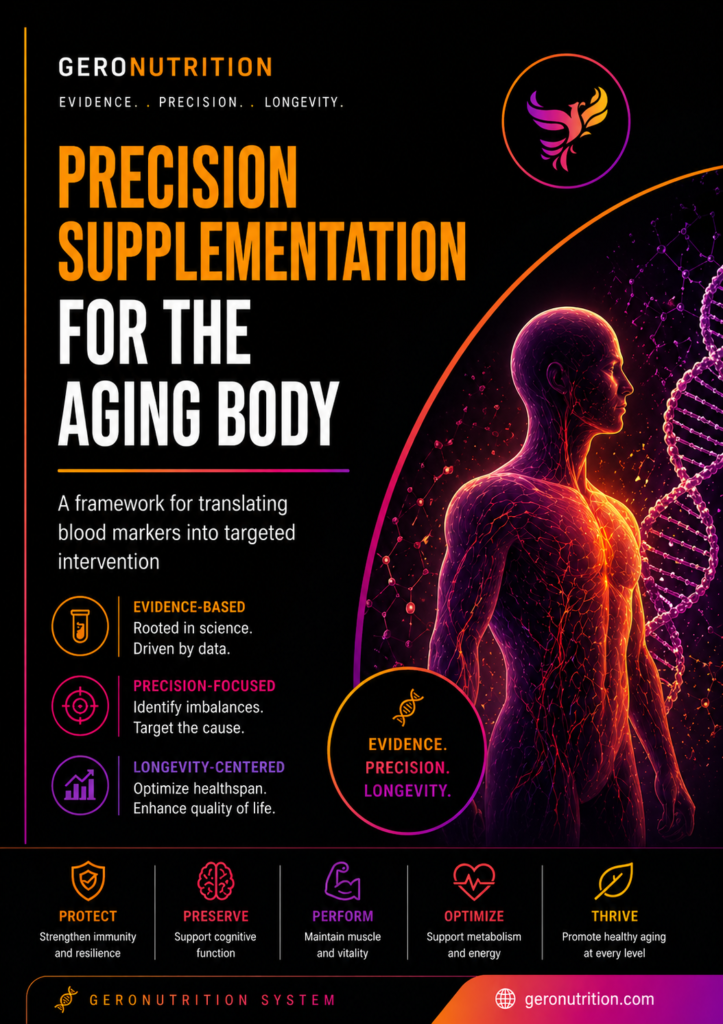
Precision Supplementation for the Aging Body is designed for readers who already understand that supplementation after 50 requires more nuance than a generic multivitamin shelf. This precision supplementation guide focuses on how aging physiology changes supplement needs, supplement tolerance, and supplement risk.
The word “precision” does not mean complicated. It means specific. A supplement plan for an active 55-year-old with good appetite is not the same as a plan for a 76-year-old with low protein intake, digestive changes, low sunlight exposure, and multiple prescriptions. The aging body requires a smarter lens.
What This Precision Supplementation Guide Covers
This e-book helps readers think through:
- Which nutrient gaps are more common after 50
- Why supplement needs change with aging metabolism
- How protein, creatine, vitamin D, calcium, magnesium, omega-3, B vitamins, and probiotics may fit into an aging nutrition strategy
- Why timing, dose, absorption, and interactions matter
- How to avoid unnecessary supplement stacking
- When professional guidance becomes important
- How to compare supplement value beyond price
Readers who want to explore related topics after downloading can continue into why supplements become necessary after 50, effective supplementation 2026, and protein muscle support.
Who Needs Precision Supplementation for the Aging Body?
This guide is best suited for:
- Adults over 50 comparing supplement options
- Seniors concerned about muscle, bones, metabolism, or cognition
- Caregivers helping older adults organize supplement routines
- Readers who already use supplements but want a better structure
- People who want to reduce wasteful supplement spending
- Visitors researching supplements for the aging body
This is also the better e-book for readers with strong commercial intent. They may be comparing products, researching supplement categories, or trying to decide which ingredients deserve priority.
Benefits of This E-book
The strongest benefit of Precision Supplementation for the Aging Body is decision quality. It helps readers avoid the two common errors of supplement use after 50: taking too little of what matters and taking too much of what does not.
Aging supplementation should not be built around hype. It should be built around physiological need, dietary intake, risk profile, medications, lab history when available, and realistic consistency. A supplement that is clinically interesting but impossible to take consistently is not a useful intervention. A supplement that is popular but mismatched to the person’s real need may create cost without value.
Which GeroNutrition E-book Should You Download First?
Both e-books work together, but they serve different reader intents. Geronutrition: Longevity Science is the better starting point for understanding the biology of aging nutrition. Precision Supplementation for the Aging Body is the better next step for readers who want a practical supplement framework.
| Comparison Point | Geronutrition: Longevity Science | Precision Supplementation for the Aging Body |
|---|---|---|
| Primary Intent | Education and biological understanding | Supplement strategy and decision support |
| Best For | Beginners, caregivers, aging nutrition learners | Adults comparing supplements after 50 |
| Core Focus | Longevity nutrition, metabolism, inflammation, nutrient absorption | Supplement selection, timing, risks, cost, and priorities |
| Reader Question | “Why does nutrition change as we age?” | “Which supplements make sense for the aging body?” |
| Clinical Depth | Broad systems-level aging science | Focused supplement reasoning |
| Commercial Intent | Moderate | High |
| Best Entry Point | Readers new to geronutrition | Readers ready to act |
| Related Cluster | Longevity nutrition science | Effective supplementation 2026 |
| Use Case | Learning, planning, caregiver education | Buying decisions, supplement audits, routine building |
| Recommended Download Order | First | Second |
Editorial Recommendation
For most readers, the best order is:
- Start with Geronutrition: Longevity Science to understand the aging body.
- Continue with Precision Supplementation for the Aging Body to build a smarter supplement plan.
- Use the Tools and Clinical Resources pillar to explore analyzers, checklists, and clinical frameworks.
This sequence creates a cleaner learning path: biology first, decisions second.
E-book Fit by Reader Need
| Reader Need | Longevity Science | Precision Supplementation | Best Choice |
|---|---|---|---|
| Understand aging nutrition basics | Excellent | Good | Geronutrition: Longevity Science |
| Learn why supplements matter after 50 | Good | Excellent | Precision Supplementation |
| Support muscle and strength planning | Excellent | Excellent | Both |
| Compare supplement categories | Moderate | Excellent | Precision Supplementation |
| Help aging parents or family members | Excellent | Good | Longevity Science |
| Build a supplement shopping strategy | Moderate | Excellent | Precision Supplementation |
| Understand metabolism and inflammaging | Excellent | Good | Longevity Science |
| Reduce supplement confusion | Good | Excellent | Precision Supplementation |
| Create a long-term healthy aging plan | Excellent | Excellent | Both |
Who Needs These E-books?
The GeroNutrition e-book library is built around real user intent. Different visitors arrive with different levels of knowledge, urgency, and concern.
Adults Over 50
Many adults over 50 begin noticing changes that feel subtle but persistent: lower energy, slower recovery, reduced strength, weight gain around the waist, poorer sleep, or a sense that the old diet no longer works. These e-books help connect those experiences to aging physiology.
Adults Over 60
After 60, nutrition becomes more closely tied to independence. Muscle mass, balance, bone density, appetite, digestion, hydration, and micronutrient sufficiency all matter more. The e-books help readers understand why nutrition after 60 deserves a more deliberate plan.
Caregivers and Family Members
Caregivers often need practical language. They may be helping a parent eat better, manage supplements, prevent frailty, or understand why low appetite is not harmless. The e-books give caregivers a structured way to think about nutrition without reducing the older adult to a list of problems.
Supplement Buyers
People searching for supplement information often face a crowded market. The precision supplementation guide helps them compare supplement categories more carefully and avoid buying based only on labels, trends, or exaggerated promises.
Wellness Professionals and Health Writers
For professionals creating education content, these guides offer a structured view of geronutrition topics. They can help organize conversations around muscle support, nutrient gaps, aging metabolism, inflammaging, and supplement decision-making.
Benefits of Downloading GeroNutrition E-books
The main benefit of downloading these e-books is continuity. A website article answers one question. An e-book builds a guided path.
1. Better Understanding of Aging Physiology
Readers learn why aging changes nutrition requirements. This includes digestion, absorption, metabolism, inflammation, muscle preservation, and mitochondrial health.
2. Smarter Supplement Decisions
The supplement market is noisy. A structured supplements for aging body guide helps readers think in categories: deficiency support, muscle support, bone support, metabolic support, cognitive support, gut support, and inflammation balance.
3. Easier Caregiver Education
Caregivers often need clear explanations they can revisit. A downloadable guide is easier to share, print, and discuss.
4. Reduced Confusion
Instead of jumping between conflicting claims, readers get a sequence: understand the body, identify priorities, evaluate options, and act carefully.
5. Stronger Connection Between Food and Supplements
The e-books do not treat supplements as replacements for nutrition. They frame them as supportive tools when diet, absorption, age-related physiology, or clinical context creates a need.
Trends and Latest Tech in Aging Nutrition E-books
Digital health education is changing. E-books are no longer simple PDF brochures. The strongest clinical resources are becoming more interactive, more personalized, and more connected to decision tools.
Interactive Learning Paths
Modern e-books increasingly work alongside calculators, analyzers, checklists, and downloadable worksheets. A reader may start with a guide, then move into a nutrition risk tool or supplement checklist. This is why the E-books page fits naturally inside the Tools and Clinical Resources pillar.
Personalization by Aging Profile
The next stage of geronutrition education is profile-based learning. A 52-year-old strength-focused reader has different needs from an 82-year-old with low appetite and frailty risk. E-books can help introduce this concept, while tools and analyzers make it more specific.
Clinical-Style Supplement Audits
Readers increasingly want to know whether their supplement routine makes sense. They are not only asking, “What is the best supplement?” They are asking, “What am I missing, what am I duplicating, and what might conflict with my situation?” Precision supplementation content is becoming more valuable because it reflects this mature search behavior.
Mobile-First Reading
Many older adults and caregivers read health content on phones. E-books should be clean, scannable, printable, and easy to navigate. Long blocks of dense text are less useful than structured chapters, charts, decision tables, and summaries.
Downloadable Companion Tools
The most useful e-book ecosystems include companion resources: nutrient deficiency checklists, protein intake planners, supplement timing sheets, caregiver notes, and clinical question prompts for doctor visits.
Upcoming Longevity books
The GeroNutrition e-book library can expand into several future models that match high-intent visitor needs.
1. Condition-Focused E-books
Future resources may focus on aging-related concerns such as sarcopenia, bone loss, metabolic slowdown, cognitive risk, gut health, and inflammation. Each e-book can connect back to a major cluster, such as sarcopenia and aging or mitochondrial health aging.
2. Supplement Stack Guides
A practical future model could organize supplements by goal: muscle support, bone support, metabolic support, cognitive support, immune support, and gut support. This would serve strong commercial search intent while maintaining clinical responsibility.
3. Caregiver Nutrition Guides
Caregivers need a different format. A caregiver e-book could focus on appetite decline, meal planning, hydration, protein support, supplement organization, and warning signs that require professional attention.
4. Printable Clinical Worksheets
Downloadable worksheets could help readers track food intake, protein patterns, supplement timing, symptoms, lab questions, and doctor discussion points.
5. Premium Clinical Resource Bundles
A future bundle may combine e-books, checklists, trackers, and decision frameworks into a complete healthy aging resource kit.
Costs: What Should Readers Consider?
The cost of an e-book should be judged by its practical value, not only its price. A low-cost guide that prevents supplement waste can save more money than it costs. A clear nutrition guide that helps a caregiver organize food and supplement priorities may reduce confusion, duplicated purchases, and unnecessary trial-and-error.
Cost Factors That Matter
| Cost Factor | Why It Matters |
|---|---|
| Download price | FREE |
| Practical usefulness | A guide should help readers take better action |
| Update frequency | Aging nutrition changes as research and products evolve |
| Printable value | Some readers prefer worksheets and checklists |
| Supplement savings | Better decisions may reduce unnecessary purchases |
| Caregiver value | A structured guide can save time and reduce confusion |
Editorial Cost Perspective
For readers comparing health e-books, the best value is not the longest file. It is the guide that helps them understand what to do next. A strong e-book should explain concepts, organize decisions, and help the reader avoid both under-supporting and over-supplementing the aging body.
Risks: What Readers Should Know Before Using Aging Nutrition E-books
E-books are educational tools. They are not a replacement for medical care, diagnosis, or individualized treatment. This is especially important for older adults because aging often comes with medications, chronic conditions, altered kidney function, digestive changes, and higher sensitivity to dosing errors.
Supplement Interaction Risk
Some supplements may interact with medications or medical conditions. Older adults using blood thinners, diabetes medication, blood pressure medication, thyroid medication, kidney-related treatment, or multiple prescriptions should be especially cautious.
Over-Supplementation Risk
More is not always better. Fat-soluble vitamins, minerals, and concentrated extracts can create problems when taken unnecessarily or in excessive amounts.
False Confidence Risk
A guide can improve health literacy, but it cannot see the reader’s lab results, medication list, symptoms, or medical history. Readers should use the e-books as education and preparation, especially before speaking with a clinician.
Low-Quality Product Risk
Supplement quality varies. Readers should be cautious with exaggerated claims, unclear dosages, proprietary blends, and products that promise dramatic anti-aging results.
Delayed Care Risk
Nutrition support is valuable, but unexplained weight loss, severe fatigue, repeated falls, cognitive changes, swallowing difficulty, persistent appetite loss, or sudden weakness should not be handled through supplements alone.
E-book Decision Framework
E-book Selection by Search Intent
| Search Intent | Reader Example | Best E-book |
|---|---|---|
| Informational | “What is geronutrition?” | Geronutrition: Longevity Science |
| Problem-solving | “Why am I losing muscle after 60?” | Geronutrition: Longevity Science |
| Commercial | “Best supplements for aging body” | Precision Supplementation for the Aging Body |
| Comparative | “Which supplement guide is best for seniors?” | Precision Supplementation for the Aging Body |
| Caregiver | “How do I help my parent eat better?” | Geronutrition: Longevity Science |
| Planning | “How do I build a healthy aging nutrition plan?” | Both |
| Risk awareness | “Are supplements safe for older adults?” | Precision Supplementation for the Aging Body |
Topic Coverage Chart
| Topic | Longevity Science E-book | Precision Supplementation E-book |
|---|---|---|
| Nutrition after 60 | High | Medium |
| Aging metabolism | High | Medium |
| Nutrient absorption | High | High |
| Protein and muscle | High | High |
| Bone support | Medium | High |
| Cognitive support | Medium | Medium |
| Supplement timing | Low | High |
| Supplement safety | Medium | High |
| Cost and value | Low | High |
| Caregiver education | High | Medium |
How to Use These E-books Effectively
The best way to use these guides is not to read them once and forget them. Treat them like a working library.
Start by reading Geronutrition: Longevity Science to understand the main systems of aging. Highlight the chapters that match your current concern: muscle, metabolism, inflammation, nutrient absorption, or deficiencies.
Then read Precision Supplementation for the Aging Body with a practical lens. Write down the supplements you currently take, the reason you take each one, the dose, the timing, and whether the reason still makes sense. This simple audit often reveals duplication, missing priorities, or unclear habits.
After that, use the website clusters to deepen specific questions. For example, if protein and muscle loss stand out, move into protein muscle support. If nutrient gaps are the concern, continue with nutrient deficiencies in older adults. If the concern is cellular energy and aging, explore mitochondrial health aging.
Practical Takeaway
The GeroNutrition e-books library is designed for readers who want aging nutrition explained with structure, not noise. Geronutrition: Longevity Science gives the biological foundation. Precision Supplementation for the Aging Body turns that foundation into a smarter supplement decision framework.
Used together, they help readers understand what changes with age, why those changes matter, and how nutrition and supplementation can be approached with more discipline. The goal is not to chase every new longevity trend. The goal is to build a clear, evidence-aware, aging-specific nutrition strategy that supports strength, resilience, and long-term independence.
FAQs
What is the best geronutrition e-book for healthy aging after 50?
The best starting point is Geronutrition: Longevity Science because it explains the core biology behind nutrition after 50. It helps readers understand aging metabolism, muscle loss, inflammation, nutrient absorption, and common deficiencies. This foundation is important before making supplement decisions because many older adults buy products without understanding the biological reason behind them. Once the reader understands the aging body, Precision Supplementation for the Aging Body becomes the logical next step.
Which longevity science e-book should caregivers read for aging parents?
Caregivers should begin with Geronutrition: Longevity Science because it explains aging nutrition in a broad, practical way. It can help family members understand why an older adult may need more protein, better hydration, more nutrient-dense meals, or closer attention to vitamin and mineral status. The guide is useful for caregiver education because it connects daily issues such as fatigue, low appetite, weakness, and recovery with deeper nutritional patterns.
Is a precision supplementation guide useful for adults over 60?
Yes, a precision supplementation guide can be especially useful for adults over 60 because supplement needs become more individualized with age. Older adults may have lower nutrient absorption, reduced appetite, less sun exposure, medication interactions, or higher risk of muscle and bone decline. A precision-based guide helps readers think beyond generic supplement lists and consider purpose, safety, timing, cost, and relevance.
Do GeroNutrition e-books help with supplements for aging body concerns?
Yes, the e-books are designed to help readers understand supplements for aging body concerns such as muscle support, bone health, nutrient gaps, metabolism, and inflammation. The Precision Supplementation for the Aging Body guide is especially relevant for readers comparing supplement categories or trying to organize an existing routine. It does not treat supplements as magic solutions; it frames them as tools that should match biological need.
Are downloadable aging nutrition guides better than reading blog articles?
Downloadable aging nutrition guides are better for structured learning, while blog articles are better for answering specific questions. An e-book gives readers a sequence and helps them connect topics such as metabolism, nutrient absorption, sarcopenia, inflammation, and supplementation. Blog articles remain valuable for deeper cluster exploration, but e-books are easier to save, print, share, and revisit.
People Also Ask
What should an aging nutrition guide include for adults over 50?
A strong aging nutrition guide should include protein needs, nutrient absorption changes, metabolic shifts, inflammation, muscle preservation, bone support, digestive health, hydration, and common deficiencies. It should also explain how food and supplements work together. The best guides do not simply list nutrients; they explain why those nutrients become more important with age and how readers can think about them in daily life.
How do I choose between a longevity science e-book and a supplement e-book?
Choose a longevity science e-book first if you want to understand how aging changes the body. Choose a supplement e-book first if you already know your main concern and want practical decision support. For most readers, the best pathway is to read the longevity guide first, then use the supplement guide to make more specific choices about protein, vitamin D, magnesium, omega-3, calcium, creatine, or other aging-related nutrients.
Why do supplements become more important after 50?
Supplements can become more important after 50 because the body may absorb nutrients less efficiently, appetite may decline, muscle maintenance becomes harder, and certain deficiencies become more common. This does not mean every adult over 50 needs a large supplement stack. It means supplementation should be considered more carefully, especially when diet, lifestyle, medication use, or clinical history increases the risk of nutrient gaps.
What is the difference between geronutrition and general nutrition?
General nutrition focuses on broad dietary health across the lifespan. Geronutrition focuses specifically on how aging changes nutritional needs, metabolic response, muscle maintenance, inflammation, digestion, and nutrient status. It looks at the older body as a distinct biological context. That distinction matters because advice that works for a younger adult may be incomplete for someone over 60.
Can e-books help reduce supplement mistakes in older adults?
Yes, a well-designed supplement e-book can reduce mistakes by helping readers understand why they are taking each supplement, what risks to consider, and how to avoid unnecessary duplication. Many supplement routines grow over time without a clear plan. A precision guide encourages readers to organize supplements by purpose, review cost and safety, and discuss higher-risk choices with a qualified clinician when needed.